
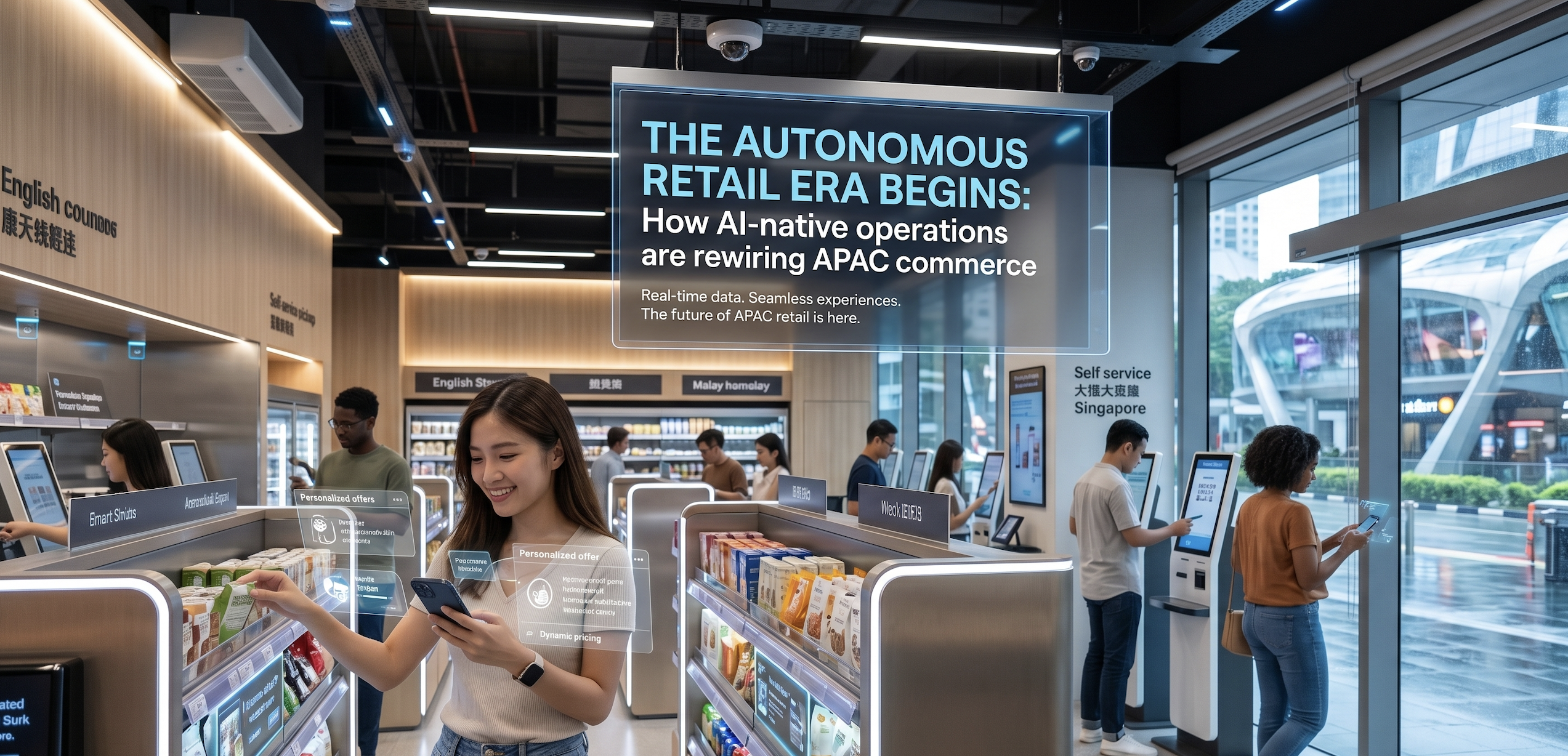
For years, the retail industry talked about prediction. Predictive analytics promised sharper forecasting, smarter pricing and better demand planning. But across APAC, the conversation is now shifting towards something far more ambitious: autonomous execution.
Ahead of NRF 2026: Retail’s Big Show Asia Pacific (NRF 2026 APAC), technology leaders are describing a retail future where AI no longer simply recommends actions to humans but increasingly orchestrates operations in real time across supply chains, fulfillment networks, store floors and payment ecosystems.
That transition, from prediction to intelligent execution, could define the next era of APAC retail. Insights gathered from exhibitors and participants ahead of the show reveal a striking trend: AI-native retail is no longer just about efficiency. It is increasingly about resilience, adaptability, trust and ecosystem orchestration at scale.
From predictive analytics to operational intelligence
Ana Friedlander, senior industry solution and strategy director at Infor, argued that the retail industry is now experiencing a fundamental shift in executive thinking.
“For decades, retailers used predictive analytics to forecast what might happen. Today, AI is beginning to decide what happens next,” she said.
According to Friedlander, AI-driven retail platforms are increasingly capable of sensing disruptions, making decisions and triggering operational actions in real time; from dynamic pricing adjustments and inventory reallocation to fulfillment rerouting and hyper-personalised customer engagement.
The implications are particularly significant in APAC, where retailers operate across one of the world’s most fragmented and volatile commercial environments. Supply chains stretch across multiple jurisdictions, consumer behaviour shifts rapidly across markets, and geopolitical tensions continue to reshape sourcing and logistics strategies.
In that environment, traditional retail operating models built around static planning cycles are increasingly proving inadequate.

IMAGE: Infor
“The most successful retailers in APAC are not just using AI to improve efficiency,” Friedlander said. “They are redesigning their businesses around adaptability.”
That adaptability is becoming critical as retailers face a convergence of pressures: inflation, labour shortages, unpredictable demand swings, climate-related disruptions, and growing customer expectations for speed and convenience.
The result is a new generation of AI-native retail infrastructure that combines cloud computing, edge intelligence, robotics, AI platforms and real-time analytics with continuously adaptive operating systems.
According to Zebra Technologies, the transformation is already visible on the frontline.
George Pepes, APAC vertical solutions lead for retail at the company, said retailers are increasingly connecting signals from RFID, computer vision, workforce systems, mobile devices and inventory platforms to enable intelligent operations that help retailers sense, analyse and act in real time.
Importantly, the industry’s vision of AI-native retail does not appear to centre on replacing humans altogether. Instead, many technology leaders are advocating what Infor describes as “AI-orchestrated and human-led” retail environments.
Pepes reinforced that point, noting that retail remains fundamentally a human-centred industry where trust, governance and customer experience matter.
That emphasis on trust may become one of the defining themes of the next retail era.
The rise of trusted autonomous commerce
As agentic AI systems begin participating in commerce; from evaluating products, applying customer preferences, to potentially completing transactions autonomously; the challenge shifts beyond efficiency towards accountability, identity verification and governance.
Johann Suchon, senior vice president for consumer acquisition and engagement, Asia-Pacific at Mastercard, believes trust will become the central pillar enabling autonomous commerce.
“Agentic AI can evaluate options, apply preferences and complete parts of the purchase journey, sometimes in the background,” Suchon said. “But as autonomy increases, the real constraint is trust.”
He added that the future of AI-driven commerce depends heavily on the ability to verify identity, prove user intent, and create auditable records of decisions.
That focal point on trusted ecosystems may ultimately reshape competitive dynamics across retail itself.

IMAGE: Zebra Technologies
APAC’s retail future will be ecosystem driven
Increasingly, success may no longer depend on which retailer owns the best standalone technology stack. Instead, competitive advantage could come from the ability to orchestrate interconnected ecosystems spanning data platforms, payment networks, logistics providers, suppliers, developers and AI models.
“The real competitive advantage is shifting from standalone technology ownership to ecosystem agility,” Friedlander said.
Suchon echoed the same theme from a payments and commerce perspective. “Retail winners will be defined less by individual technologies and more by how well they orchestrate ecosystems,” he said.
That orchestration challenge becomes even more complex in APAC, where localisation remains essential.
Retail AI systems deployed across Japan, Southeast Asia, India and Greater China must operate on unified enterprise data architectures while adapting to vastly different regulations, digital ecosystems, consumer behaviours and fulfillment realities.

Cloud, edge and robotics are becoming retail’s new operating infrastructure
According to Infor and Zebra Technologies, the future belongs to globally connected, locally intelligent operating models that combine centralised visibility with localised execution.
Behind the scenes, much of this transformation is being powered by hybrid architectures that blend cloud scalability with edge computing and specialised AI hardware.
Cloud platforms provide enterprise-wide orchestration and connectivity. Edge computing enables real-time decisions inside stores, warehouses and fulfillment environments. Meanwhile, AI-optimised infrastructure increasingly powers the massive computational workloads required for GenAI, machine vision and autonomous decision making.
“What’s emerging is a hybrid intelligence architecture,” Friedlander said. “Cloud for enterprise-wide orchestration, edge for real-time execution, and AI infrastructure for advanced analytics and autonomous decision making.”
At the same time, robotics and automation are beginning to redefine operational economics inside warehouses and fulfillment centres across the region.
Both Infor and Zebra Technologies identified warehousing and fulfillment as the areas currently generating the clearest return on investment for automation initiatives.
Yet the next frontier appears to be intelligent frontline operations: environments where AI-powered workflows, RFID visibility, computer vision and connected devices continuously coordinate store activity in real time.
The broader implication is that APAC retail may be entering a new operational paradigm altogether. Retailers are no longer merely digitising legacy workflows. They are beginning to construct continuously learning operational ecosystems capable of sensing disruption, adapting dynamically and increasingly executing decisions autonomously.
And if the industry’s direction is becoming clearer, so too is the emerging competitive reality: in an age of AI-native retail, the winners may not be the retailers with the most technology, but the ones capable of building the most adaptive, intelligent and trusted operational ecosystems.
It’s time for “The Next Now” of APAC retail
This year’s NRF APAC show arrives at a pivotal moment for the retail industry.
Centred around the event theme “The Next Now”, the show reflects how APAC retail is entering an era where transformation is no longer theoretical or hypothetical. Across the region, retailers are already grappling with the operational realities of AI-native commerce, autonomous workflows, intelligent fulfillment, and increasingly volatile consumer and geopolitical environments.
In many ways, “The Next Now” captures the growing realisation that the next generation of retail infrastructure is already being built in real time.
That evolution will be visible across the show floor and conference stages at NRF 2026 APAC this June in Singapore, where technology leaders and innovators are expected to showcase how AI, automation, intelligent infrastructure and ecosystem orchestration are reshaping retail operations across APAC.