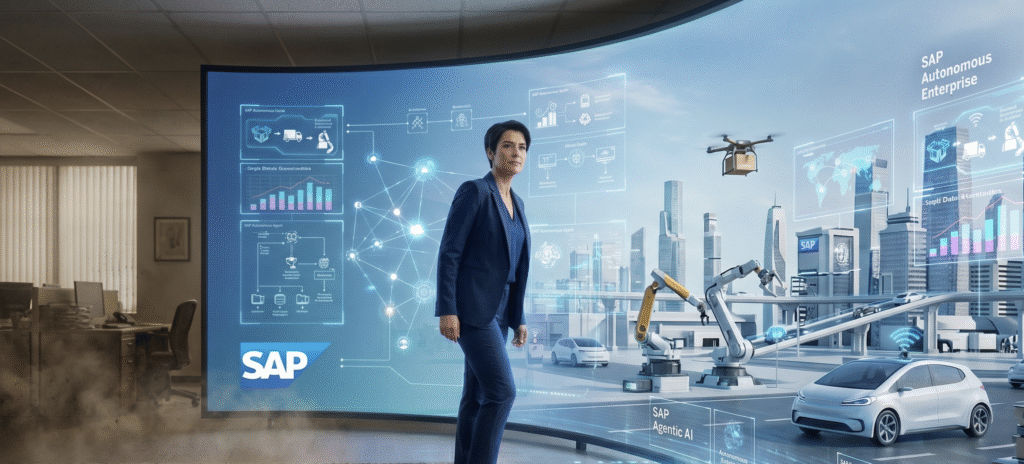
The most revealing moment at SAP’s Sapphire 2026 conference wasn’t a product demo. It was a question.
CEO Christian Klein opened his keynote by asking the audience whether SAP would even be a software company in the future. The answer, by the end of the summit, was essentially: not in any way its customers would currently recognise.
What SAP announced in mid-May 2026 was less a product roadmap than an ideological repositioning. It was a declaration that the era of keyboard-driven enterprise software is ending, and that SAP intends to own whatever replaces it.
The company calls this destination the “Autonomous Enterprise” – a model in which governed AI agents execute mission-critical workflows end-to-end, with human workers reduced to declaring intended outcomes in natural language and trusting the system to handle the rest.
It is an audacious bet. It may also be the right one.
The architecture of letting go
The structural logic behind SAP’s pivot is cleaner than most enterprise AI narratives.
Rather than layering AI features onto existing products, the company has designed a unified three-tier stack: a business AI platform anchored by the SAP Knowledge Graph at the foundation; an autonomous suite of 51 domain-specific assistants coordinating 224 specialised agents across finance, supply chain, procurement and HR in the middle; and Joule Work, a natural language interface, as the new primary front door for employees.
The Knowledge Graph is the decisive ingredient. It gives AI agents a structured, semantic map of business entities, compliance rules and systemic relationships, the kind of institutional context that raw LLM horsepower simply cannot manufacture. It is, in my view, a key differentiator against its competition.
To shore up the compliance layer, SAP has tapped Anthropic’s Claude as a primary reasoning engine across the suite, alongside NVIDIA’s OpenShell framework for step-level data governance, ensuring agents cannot take unauthorised actions. An Agent Hub telemetry layer records every micro-decision, data retrieval and logic branch in a verifiable audit trail, a feature aimed squarely at the CFOs and corporate auditors who will ultimately decide whether to hand the keyboard over.
This matters because the central tension in enterprise AI is not capability: it is trust. LLMs are probabilistic by nature, operating on statistical inference. Enterprise finance and supply chain operations are deterministic by necessity. In SAP’s own framing, “almost right” is an existential failure. The audit trail architecture is an attempt to bridge that gap without pretending it doesn’t exist.
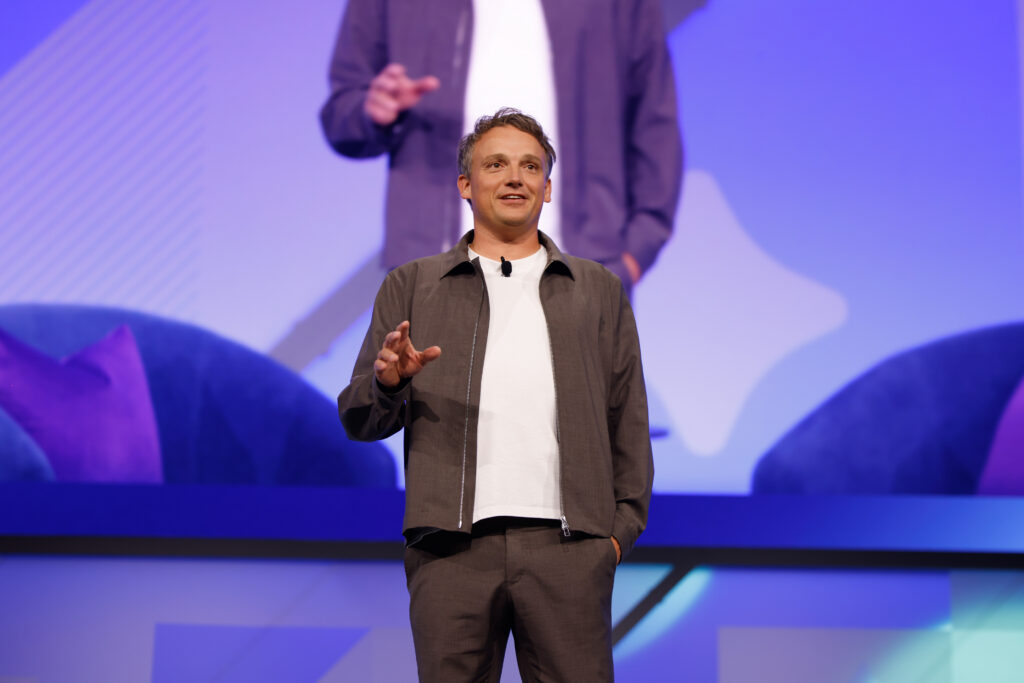
IMAGE: SAP
The risks that remain
None of this resolves the deeper challenge SAP is navigating.
The cultural and organisational resistance to agentic enterprise software is real and underestimated. Handing autonomous agents control over purchase approvals, financial reconciliation and multi-step onboarding processes requires a degree of institutional trust that audits and telemetry can support but not manufacture. Companies that have spent decades building compliance cultures around human sign-offs will not abandon them because an AI agent can produce a clean audit trail.
There is also a competitive question.
SAP’s core argument, that proprietary business context and process data constitute an insurmountable moat, is structurally sound but historically fragile. The same claim has been made and eroded across multiple enterprise software cycles. The Knowledge Graph is compelling today: its durability depends entirely on how quickly rivals build equivalent contextual depth.
Rise and grow
SAP continues to double down on two migration pathways.
RISE with SAP targets established enterprises modernising complex legacy systems, offering AI-assisted migration tools that reportedly cut ERP migration effort by up to 35 per cent. SAP GROW targets greenfield customers (startups, fast-growing mid-market firms) with a standardised public cloud ERP designed to go live in as little as four weeks.
For instance, Levi Strauss, an American clothing company with global offices, accelerated its shift towards a direct-to-consumer business. It recognised that greater speed and scale would require a lean technology landscape. Jason Gowans, chief digital and technology officer, said the company started by consolidating nine ERP systems into a single global foundation with RISE with SAP, standardising processes and establishing a clean core.
That unified backbone now supports Levi’s ambitious AI strategy, with already more than 1,000 AI agents in production across the business.
The impact is already visible: one example is wholesale order processing. While 80 per cent of orders already flow through automatically, the remaining 20 per cent, often submitted by smaller customers through handwritten notes, emails or unstructured documents, previously took two to five days to process manually. For Levi Strauss, the lesson is clear: standardisation does not limit agility; it makes it possible.
The commercial traction on the GROW track is also substantive.
Liher Urbizu, president and managing director for Southeast Asia at SAP, pointed to the following: Singapore payment provider AXS consolidated its legacy operations onto the platform in three months. Digital services firm Mindsprint executed its deployment in six months, delivering a 30 to 50 per cent acceleration in financial closing cycles alongside automated revenue recognition.
Medical device manufacturer Medplast in Thailand used the architecture to optimise order-to-cash cycles and build international compliance infrastructure. Malaysian real estate group PHB, managing a portfolio valued at MYR11 billion, adopted the platform to automate compliance with evolving local accounting frameworks.
These metrics are music to the ears of the CFO: measurable, attributable and defensible in a budget review. They also signal a deliberate maturation in how SAP is choosing to compete. In a market where every software vendor is claiming AI transformation, the ability to point to concrete reductions in processing time and manual overhead is a genuine differentiator.

IMAGE: SAP
Southeast Asia as test bed for innovation
Urbizu said that SAP has committed more than SGD300 million to Southeast Asia, and deployed engineers across labs units in Singapore and Vietnam.
The Singapore lab alone had grown to almost 400 engineers as of early 2026, while the Vietnam facility, launched in August 2025 with a planned investment of over €150 million, is targeting a combined regional headcount of over 900 by 2027.
The region is a logical proving ground: AI is projected to inject up to US$1 trillion into the Southeast Asian economy by 2030, and the mid-market SMEs that make up roughly 80 per cent of SAP’s Asia-Pacific customer base are unburdened by the legacy technical debt that complicates AI adoption elsewhere.
For these companies, the question is not how to retrofit an existing architecture but which architecture to build on from scratch.
That foundation is already deeper than the Sapphire announcements alone suggest. SAP’s Document AI solution, which originated from the Singapore lab, has quietly become one of the company’s most consequential embedded AI deployments this year, processing billions of invoices, purchase orders, contracts and shipping documents for tens of thousands of customers worldwide. It is an advanced AI capability delivered directly inside existing workflows, with no complex integrations or specialist expertise required.
For the mid-market enterprises SAP is courting across Southeast Asia, where manual document handling remains a persistent drag on operational velocity, this kind of frictionless, embedded automation is precisely the entry point that makes the broader autonomous enterprise proposition credible.
What SAP has done at Sapphire 2026 is articulate the clearest version yet of where enterprise software is heading.
The Autonomous Enterprise is an architectural commitment, backed by a coherent commercial strategy and an emerging body of real-world evidence. Whether SAP can hold its position at the centre of that transformation is the question its next few years will answer.