Image generated by Deeptech Times using ChatGPT
If your mental model of a library is stern desks and shushing, you’re thinking of a 20th century institution. Today’s libraries are shipping something closer to a platform, combining archives, collaboration space and increasingly, AI infrastructure in one building.
Librarians’ roles are shifting too, moving from gatekeepers to data navigators who help people move through an information landscape that has gone mostly virtual.
The National University of Singapore’s Central Library is a useful example of this shift in action. As the flagship library across NUS Libraries, it draws more than a million visits a year.
Opened in 1978, the building went through a multi-year renovation starting in 2018. Rare print materials now sit inside an elevated “BookBridge” while the lower floors have been repurposed into a student activity hub.
Its latest addition is AI Sense Maker (ASM), which makes NUS the first university in Southeast Asia to deploy conversational AI in support of student and faculty research.
Under the hood
ASM was built jointly by NUS Libraries and NUS Information Technology (NUS IT). It is a web-based platform running on GPT-4, grounded in NUS’s own source database through retrieval augmented generation (RAG). Guardrails block open internet search and are designed to reduce hallucinated output. This also preserves source credibility.
The interaction model is natural language rather than keyword search. A query like “Why do some neighbourhoods in Singapore feel hotter than others?” gets handled through semantic search, which matches on meaning and intent so it can surface relevant sources that use entirely different vocabulary.
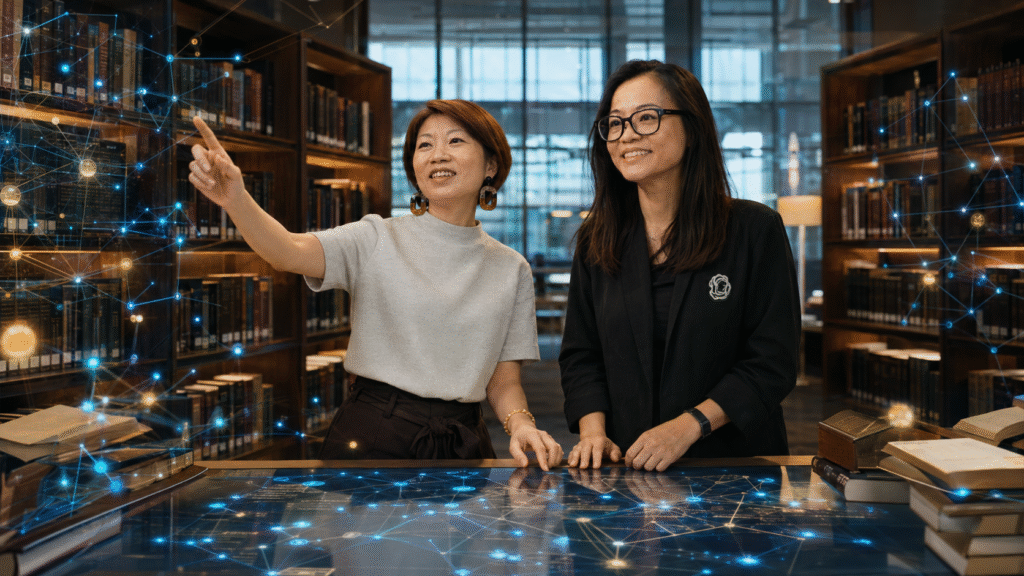
From there, ASM generates concise topic summaries, curates references for further reading, and builds interactive knowledge graphs that show how concepts connect across disciplines.
On the urban heat example, the graph links contributing factors such as building density, lack of greenery, surface materials and water features to broader research themes including urban ecology, environmental science, atmospheric physics and microclimatology.
Scale and rollout
ASM serves a user base of 7,500 academic staff and 45,000 graduate students. It officially launches on August 20, 2026. At launch, it will be indexed against 150,000 digitised materials drawn from ScholarBank, NUS’s research paper repository, and Digital Gems, NUS Libraries’ digitised special collections of rare materials and primary sources.
NUS research papers span engineering, life sciences, medicine, humanities and computing, while its rare Southeast Asian collections cover the humanities, social sciences, natural sciences and medicine, with materials dating back to the 17th century.
Highlights include the first printed edition of Sir Stamford Raffles’ memoir, The History of Java, published in 1817. The oldest item in NUS Libraries’ collection dates to the 14th century, while the oldest digitised book dates to the 17th century.
“Researchers today are not short of information; they are short of time and clarity,” said Associate Professor Natalie Pang, University Librarian at NUS. She expects research groundwork that once took two weeks to compress down to roughly 30 minutes.
“AI Sense Maker is designed to help people make sense of information, not simply find it,” she said. “By connecting ideas across trusted sources, it helps students and researchers ask better questions, discover new connections and generate fresh insights.”
Tan Shui-Min, chief information technology officer, NUS IT, noted that ASM’s knowledge graphs are meant to make cross disciplinary themes and research gaps more visible, surfacing connections a standard search would miss.
The library’s core mission has stayed constant across this shift. Helping people find meaning in knowledge is still the job. AI Sense Maker is simply the newest tool for doing it.