Image generated by Deeptech Times using Google Gemini
When Taro Ikushima walked onstage at Reuters NEXT Asia 2026, people who grew up in the 1970s and 80s did a double take. TDK’s corporate officer and general manager of corporate strategy was there to talk about AI.
Before that, TDK lived on cassette shells, slid into car stereos and spun inside Walkmans. For a certain generation, TDK meant magnetic tape: the soft hiss before a song, the handwritten label, the little plastic object that made music portable and personal.
That tape was never the real invention. It was ferrite, the magnetic material a pair of Tokyo Institute of Technology researchers, Yogoro Kato and Takeshi Takei, discovered in 1930.
TDK was founded in 1935, originally as Tokyo Denki Kagaku Kogyo, to turn that lab discovery into an industry. In 2009, the IEEE named the ferrite work a milestone in electrical engineering and computing, an honour that puts TDK’s origin story in the same registry as the transistor and the telegraph. From ferrite, the company built its way into radios, televisions, personal computers, smartphones, cars and industrial systems.
When the cassette market collapsed, TDK didn’t chase nostalgia. It followed the physics. Magnetic expertise carried the company into hard disk drive heads, then passive components, sensors, power systems and batteries: the nervous tissue that modern electronics run on but nobody sees.
The body problem
Fast forward to now. Ikushima’s pitch was simple. The AI industry has spent years staring at the brain: foundation models, agents, chips, training clusters, the shimmering promise of AGI. TDK is watching the body.
If intelligence is going to leave the browser and walk into a warehouse aisle, an operating room, a factory floor or a pair of glasses on someone’s face, cognition alone won’t cut it. It needs to sense, move, endure heat, sip power and survive noise.
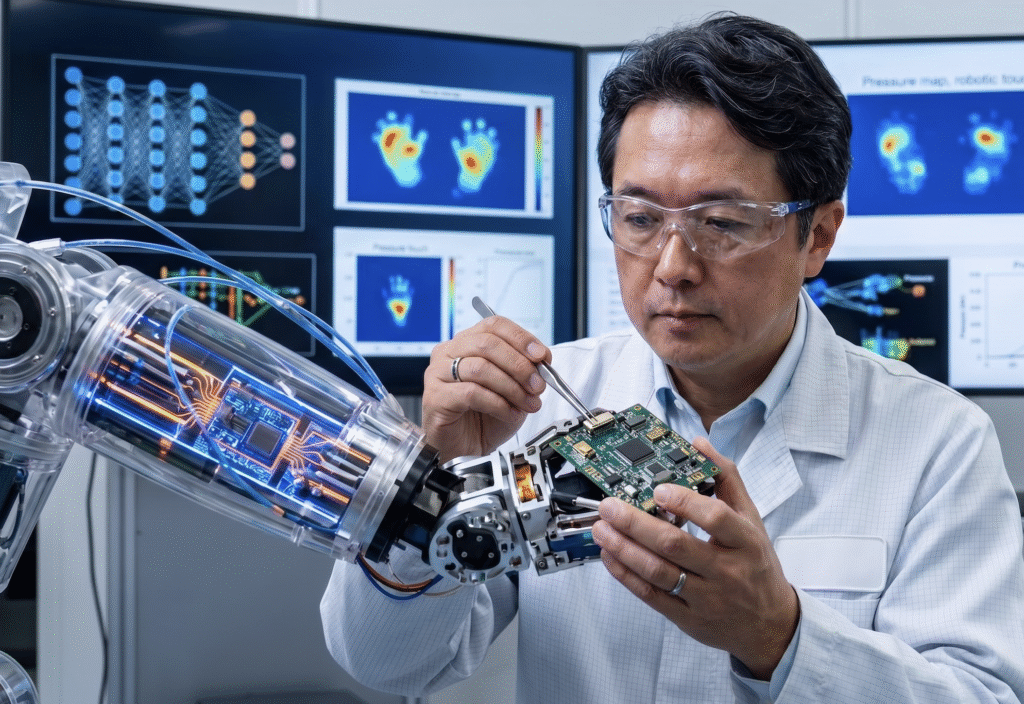
That’s the opening TDK is chasing. The company has no interest in building the robot. It wants to build what makes the robot physically possible: batteries, sensors, actuators, power supplies, magnetic components, haptics and the connectivity layer that lets machine intelligence touch the world without falling apart.
In demo videos, AI looks weightless. In the real world, it has mass. Motors overheat. Batteries drain. Sensors drift. Factory floors vibrate. Electromagnetic interference turns certainty into static. The frontier problem, as Ikushima framed it, isn’t only whether a model can reason. It’s whether the machine carrying that model can keep working when the world pushes back.
The company inside the machine
TDK has been quietly assembling that body for years. In 2017, it closed a US$1.3 billion acquisition of InvenSense, the San Jose sensor maker behind motion tracking chips found in phones, drones and gaming controllers.
The deal pushed TDK deeper into sensor fusion for IoT, automotive, industrial and communications markets, and the company named sensors and actuators, energy units and next-generation electronic components as its strategic growth areas.
The more recent moves carry a sharper AI signal. In 2024, TDK launched TDK SensEI, a Singapore-headquartered venture built to fuse edge AI with its sensor and battery portfolio, spanning motion, magnetic, microphone, current, temperature and energy-harvesting sensors. The goal is anomaly detection and machine learning running close to the machine where downtime carries a real cost.
That’s where a project like Senseair fits. It reads less like a sci-fi robot and more like a practical sensor module for predictive maintenance: a quiet box bolted to an industrial asset, tracking vibration, current, temperature and sound, turning the mechanical murmur of a plant into a warning before something breaks.
Batteries are the other half of the story. Through Amperex Technology Limited (ATL), TDK sits inside the devices people already carry: smartphones, laptops, tablets, power banks, drones, wearables and AR/VR headsets. ATL bills itself as a leading maker of lithium-ion cells built for high energy density, high power and fast charging. A wearable can’t become ambient computing if it dies before lunch.
Manufacturing is the next constraint. TDK has been linked to Fabric8Labs, a metal 3D-printing company whose technology could feed into denser cooling components for AI chipsets. Cooling sounds procedural until it becomes the thing that defines what a machine can even be. As AI hardware packs in more silicon, heat stops being a footnote and becomes architecture.
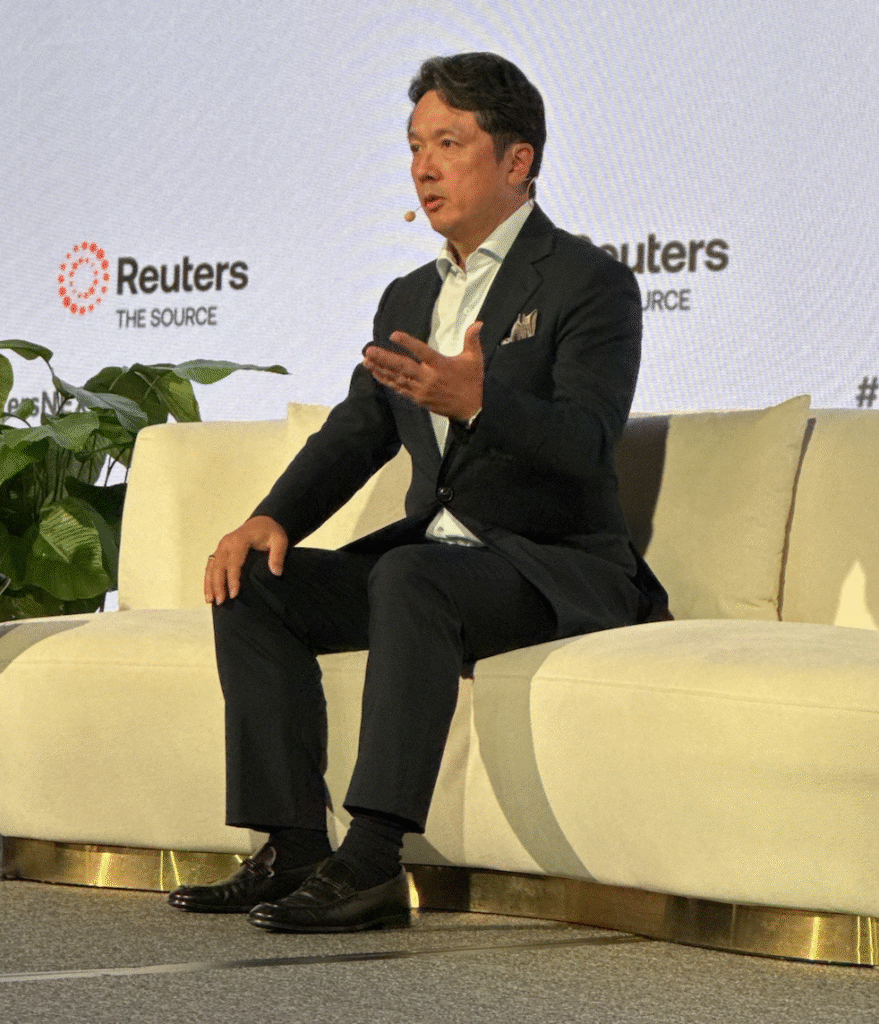
IMAGE: Deeptech Times
The new mask
In 2025, ahead of its 90th anniversary, TDK put a public face on all of this. The company unveiled a new brand identity and tagline “In Everything, Better” tied to a long-term vision it calls TDK Transformation. The pitch: an enabler behind the scenes, woven into smartphones, electric vehicles, industrial systems and energy infrastructure. The more essential TDK becomes, the less visible it gets.
Its 2024 integrated report used the same language in corporate dress, describing a company entering a new growth stage to support social transformation through green and digital transformation, TDK’s shorthand for GX and DX. The company that once sold finished tape to consumers now wants to supply the physical substrate underneath digitisation, electrification, automation and AI.
Smart glasses are the clearest test case. Earlier waves of the category promised ambient computing and delivered awkward hardware nobody wanted on their face. TDK’s bet is a more disciplined stack: smaller batteries, sharper sensors, haptics and eye-tracking technology acquired through companies such as SoftEye.
If it works, Ikushima said, augmented reality will stop feeling like a gadget strapped to your head and start feeling like an interface stitched into perception itself.
Why the reinvention matters
TDK has run this play before. A university patent on magnetic oxide became the tape that soundtracked a generation, and when that market died, the same material science migrated into disk drive heads, capacitors and battery cells without anyone much noticing.
The pattern holds now, aimed at a bigger and messier target. Model labs get the headlines, but reasoning that stays trapped in a data centre doesn’t do much for a warehouse floor or a pair of glasses. Someone has to build the batteries, sensors, actuators and cooling that let that reasoning survive contact with heat, vibration and gravity.
TDK is betting that job looks a lot like the one it already knows how to do: staying invisible inside whatever hardware wins. Whether physical AI turns into a real market or another overhyped category remains to be seen. Either way, TDK has positioned itself to profit from the wiring, not the story.