

Image generated by Deeptech Times using ChatGPT
APAC real estate is at a turning point as AI evolves from a tool for efficiency to a catalyst for reinvention. It’s reshaping how assets are managed, decisions are made and value is created.
According to Yardi and Mingtiandi, 37 per cent of APAC real estate companies now use AI, compared to just 9 per cent in 2021.
And Singapore’s property market is a sharp place to test its value. For homebuyers, the question is practical: can technology make one of life’s biggest financial decisions clearer, more trustworthy and easier to navigate?
PropertyGuru, which has recast itself a property tech company, is betting that it can, with AI tools built to tackle two stubborn pain points in the homebuying journey: misleading listings and complex housing decisions.
At the centre of this push is AIME, PropertyGuru’s internal AI moderation engine, which is designed to make online listings more reliable at scale. The system checks property images for accuracy and compliance, flagging edits that could mislead buyers, including altered layouts or structural changes. It now reviews more than 8 million images a month with 98 per cent accuracy, helping consumers place greater trust in what they see while recognising agents who list responsibly.
PropertyGuru is also testing GuruGPT, a conversational AI assistant built to simplify the more complex parts of the homebuying process. The tool helps users navigate housing policies, compare properties and assess personal scenarios, offering guidance that is tailored to their stage in the property journey.
Yi-Wei Ang, chief product and technology officer at PropertyGuru, shares more.
What problem is materially being solved here and for whom?
Property search presents two persistent challenges for consumers. The first is listing accuracy: ensuring that what people see online genuinely reflects the property. Misleading images, whether digitally enhanced or inaccurate in how they represent a space, can erode trust and lead to poor decisions on what is often a person’s largest financial commitment. AIME addresses this at scale by reviewing listing images in real time to maintain quality and accuracy across the platform.
The second is decision complexity. Singapore’s housing framework, covering loans, taxes, eligibility, grants and loan-to-value limits, is layered and constantly evolving. Understanding these rules in the context of one’s personal situation has traditionally required extensive self-research or heavy reliance on agents. We are working to give consumers better tools to make informed, confident decisions before they begin conversations with agents or financial advisers.
Both challenges point to the same underlying issue: information gaps between the platform and the buyer, and between experienced buyers who know how to navigate the system and those who do not. These tools are designed to help close those gaps.
What exactly does “98 per cent accuracy” mean in the context of AIME?
AIME’s 98 per cent accuracy refers to its ability to correctly identify listing images that do not meet PropertyGuru’s compliance standards, such as photos altered to hide structural issues or misrepresent layouts. AIME reviews more than 8 million images monthly at this accuracy level. Images flagged as non-compliant are sent to a human reviewer before any action is taken, so the system does not make the final decision on its own.
How much of this is novel versus standard moderation and chatbot functionality?
We would not describe AIME or GuruGPT as entirely new AI architectures. Both use established computer vision and large language model capabilities. What is distinctive is how deeply they are applied to the property sector: the systems are trained and fine-tuned for property data, at the scale and specificity our market requires, rather than relying on generic models.
For AIME, the challenge is not the underlying technology itself. It is training the system to identify the specific ways listing photos can be manipulated, such as altered room layouts, accurately enough that human reviewers do not need to check every image from scratch.
For GuruGPT, the focus is on Singapore’s property policy environment, helping users understand housing eligibility and property options in ways a generic chatbot is not designed to support.
We bring real estate expertise and proprietary data, combined with external AI tools, built specifically for property search, matching and decision making. That is different from simply adding generic AI to an existing platform.
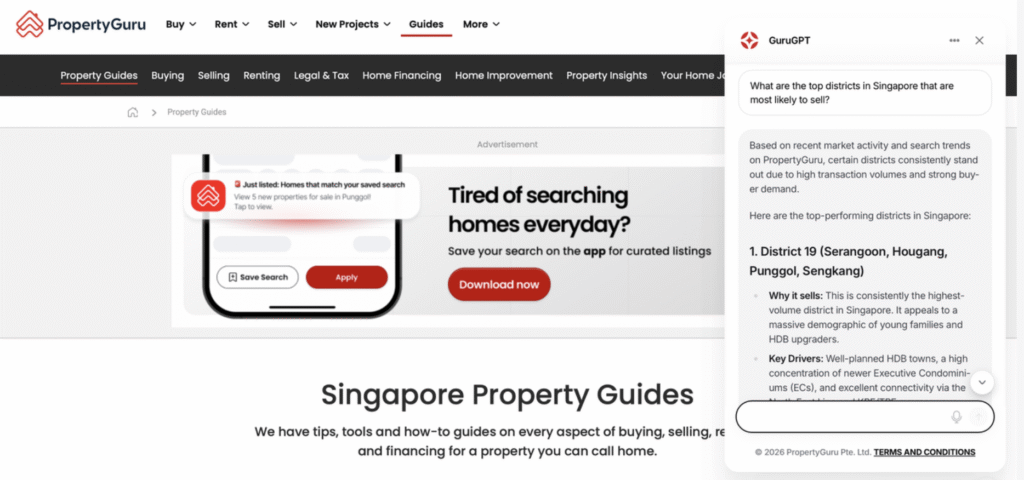
IMAGE: PropertyGuru
How do you know that users trust these tools?
The clearest signal is repeat usage. For example, our AI video tool helps agents turn listing photos and descriptions into professional-quality videos. About half of the agents who tried the tool on one listing used it again for other listings, and 60 per cent received a video they were satisfied with on the first attempt, without needing edits. The average number of AI video generations per listing also rose from 1.3 times in 2024 to 2.9 times in 2025, suggesting agents see value beyond a one-time trial.
For AIME, the evidence is operational. At the scale and accuracy rate described earlier, non-compliant listings can be identified and addressed before they reach consumers, at a volume that manual review alone could not sustain.
For GuruGPT, the signal is sustained consumer engagement. Since its beta launch in 2025, the tool has handled more than 12,000 queries, with 35 per cent month-on-month growth. This suggests consumers are returning to it rather than trying it once and moving on.
What are the risks, limitations or unintended consequences of these AI systems?
We recognise that AI is not risk-free and that governance matters as much as the technology itself. As AI-generated imagery becomes more sophisticated, the line between enhancing a listing and misrepresenting it becomes harder to police, so this is something we monitor continuously.
More broadly, AI adoption at our scale requires clear guardrails. In 2025, we updated our AI guidelines and introduced company-wide AI principles to provide a common reference point for responsible use. We use AI where it adds clear value, not as a substitute for human oversight, particularly in areas where mistakes could affect someone’s financial decisions.
The biggest challenge has not been technical failure. It has been managing expectations, both internally and externally. AI does not transform a business overnight. Bridging the gap between AI hype and the slower, more deliberate work of rolling it out responsibly remains an ongoing challenge for any leadership team.
Why is this significant specifically for Singapore’s housing ecosystem?
Singapore’s property market has a unique combination of characteristics that makes AI especially relevant.
First, the stakes are high. For most Singaporeans, property is their largest financial commitment and one of the most important decisions they will make. Decisions based on inaccurate information can therefore have significant consequences.
Second, the policy environment is complex. Singapore’s housing framework involves layered rules that interact with one another and change over time, creating a real gap between buyers who understand the system and those who do not.
Third, the scale of Singapore’s property marketplace makes manual quality checks alone unsustainable. AI allows us to uphold platform standards consistently across millions of listings, which is a practical necessity for a marketplace of this size, not just a technological ambition. We want to help people make decisions with confidence and help agents work more efficiently. That is the direction these tools are building towards.