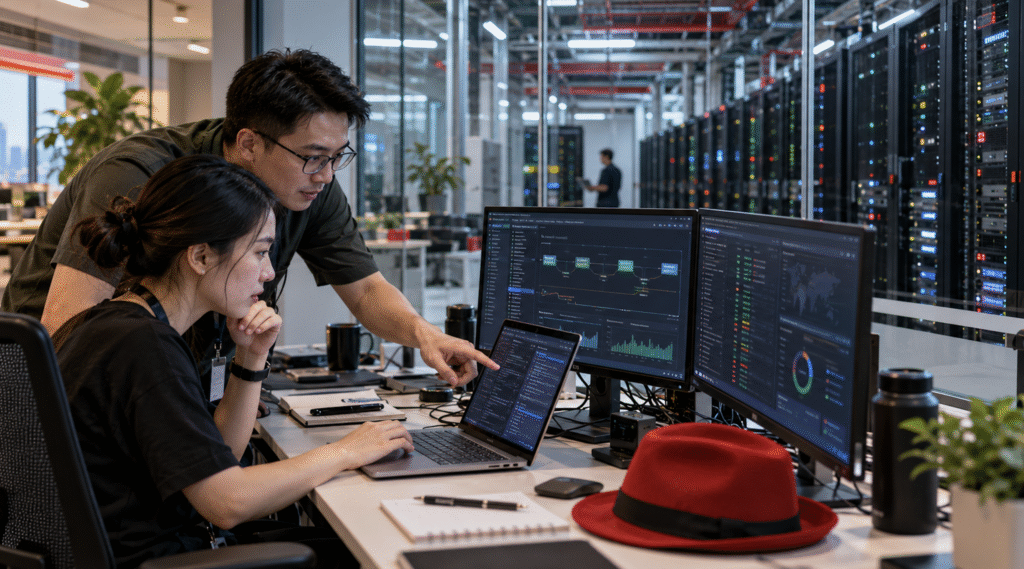
Red Hat has opened an APAC AI centre of excellence in Singapore to help organisations move AI projects from experimentation into production, with early collaborations spanning defence technology agency DSTA and telecoms group Singtel.
Supported by the Singapore Economic Development Board (EDB), the centre will develop reusable software architectures and contribute code to upstream open-source projects. Red Hat plans to start with a team of about 18 people, comprising engineers, forward-deployed engineers who work directly with customers, architects and project managers. The team can expand as demand grows.
The Singapore hub will work with Red Hat engineering teams in India, the US and Europe to feed regional customer requirements into product development. Its remit includes addressing technical challenges in AI deployment, runtime tuning, and platform management.
EDB’s support includes a skills development objective spanning software engineering, automation, cloud development and security. At the launch, EDB linked the initiative to Singapore’s ambition to develop 15,000 AI practitioners.
DSTA signs MOU to explore defence AI
Red Hat and Singapore’s Defence Science and Technology Agency (DSTA) signed a memorandum of understanding at the centre’s launch, formalising a new phase of collaboration following about two years of work together on other projects.
The agreement covers AI, cloud computing, application modernisation and processing data closer to where it is generated. The organisations also plan to explore ways to run and secure AI and cloud systems across DSTA’s infrastructure and external cloud services.
The work addresses a central challenge in defence AI: deploying models across environments with different security requirements, including legacy systems and closed networks.
Akash Philip, DSTA’s deputy director for AI development, said the agency is building a platform to test AI models against specific tasks and check their security before deployment. The process must account for models accessing sensitive data, encountering untrusted content and potentially sending information beyond protected networks.
Philip said permissions, security checks and controlled experimentation need to be incorporated into the development and deployment process. DSTA also wants to automate the movement of approved models across its networks, allowing its teams to focus on the defence tasks those systems support.
The MOU establishes a framework for further collaboration. The announcement does not identify specific defence systems already deployed through the new agreement.
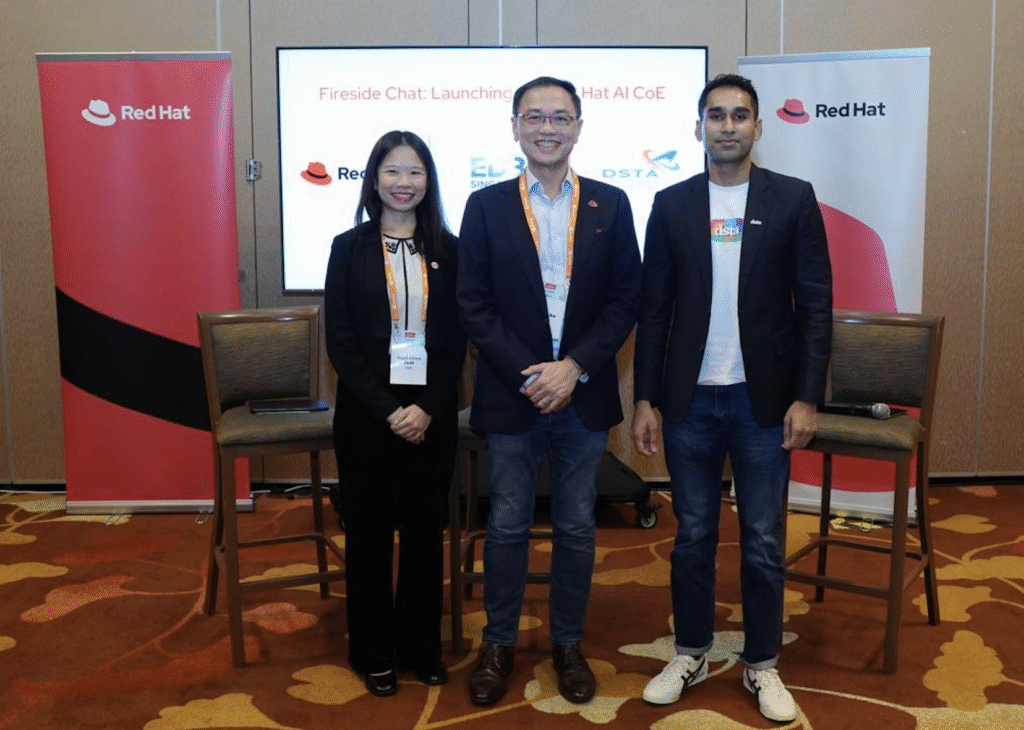
IMAGE: Red Hat
Singtel builds its own AI platform
Singtel is another early collaborator, working with Red Hat on open-source platform technology. The telecoms group developed its own AI platform to consolidate development and establish a governed approach to deploying AI across its business.
Geet Bhanawat, Singtel’s chief AI and data analytics officer, said the company moved away from a fragmented approach after finding that teams were duplicating work across separate silos.
Singtel adopted a hybrid deployment strategy, using cloud infrastructure for workloads requiring horizontal scaling and on-premises systems for applications subject to security, data residency, compliance or critical infrastructure requirements.
The company has standardised its technology and data foundations and built an on-premises sovereign inference platform. Its shared environment allows teams to reuse security guardrails, model evaluation tools, observability capabilities and common knowledge structures for AI agents.
The objective is to reduce duplicated engineering work while maintaining control over performance, costs and security. Singtel’s collaboration with Red Hat concerns the open-source platform layer, rather than the development of Singtel’s own AI platform.
One application is Shirley, Singtel’s AI system for customer interactions. Bhanawat said it handles 70 to 75 per cent of incoming calls without human involvement, with customer satisfaction above 85 per cent.
Network automation remains a challenge
Singtel is also developing AI agents to support network operations, where reliability requirements make autonomous decision making more difficult.
Its “one-five-sixty” target is to detect a fault within one minute, identify its root cause within five minutes and restore service within 60 minutes. These are aspirational targets, rather than reported performance levels.
AI agents currently assist with network operations but cannot make network decisions or changes autonomously. Bhanawat said full autonomy remains difficult because network operations require deterministic outcomes, while major incidents provide relatively few examples for training and evaluation.
Singtel is developing root-cause analysis agents and introducing them incrementally across its mobile, television and fibre networks.
The distinction matters for enterprise AI adoption. In critical infrastructure, assisting an operator is different from allowing an AI agent to change a live network. Greater autonomy requires confidence in system reliability, security and the consequences of automated actions.
Red Hat targets the gap between AI pilots and production
The Singapore centre gives Red Hat a regional engineering base to work directly with customers and translate operational requirements into reusable software components.
Its approach centres on building architectures for recurring technical problems and contributing improvements to upstream open-source projects. These include challenges involving AI deployment, runtime tuning and platform management.
The opportunity for Red Hat lies in helping enterprises and government organisations develop AI applications on infrastructure they can manage and control, while reducing the engineering work required to take those applications into production.
Singtel and DSTA illustrate two distinct requirements. Singtel is consolidating AI development across a large commercial organisation, while DSTA is exploring deployment and security across defence infrastructure and external cloud environments.
The centre’s longer-term impact will depend on how effectively it turns those customer requirements into reusable open-source technology, and how widely those improvements are adopted beyond the initial collaborations.