
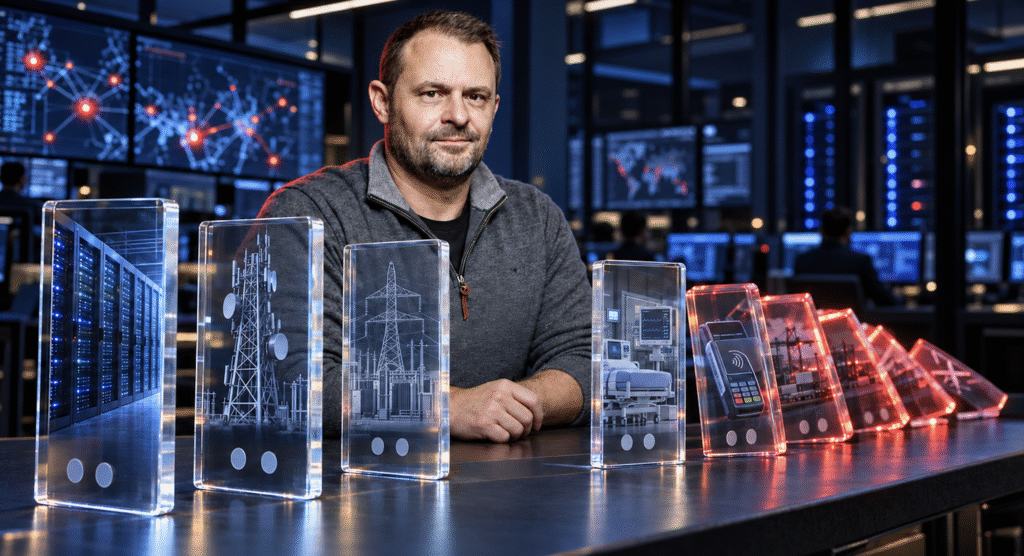
Image generated by Deeptech Times using ChatGPT
A telecommunications failure can become a healthcare emergency. A payments outage can leave consumers unable to buy essentials. Disruption to fuel distribution can interrupt the movement of food. These are the dependencies that give cyberattacks their potential reach.
AI could accelerate an attacker’s progress through them, but the underlying weaknesses belong to systems that businesses and governments have already built.
Speaking to Deeptech Times at GovWare 2026, Kevin Vanhaelen, senior vice president for Asia Pacific and Japan at Filigran, frames the danger in practical terms: malicious intent, vulnerable infrastructure and the capacity to overwhelm defenders.
That framing brings the debate closer to questions executives can investigate. Where could disruption spread? Which controls would contain it? What evidence shows that recovery would work?

Speed changes the risk calculation
Vanhaelen sees continuity between established cybercrime and attacks assisted by AI. Criminal groups and nation states still need objectives, opportunities and resources. Automation can change how quickly they pursue them.
“It still comes down to intent,” he says. His argument deserves qualification. Even where an attacker’s objective remains unchanged, faster execution can materially alter the defender’s position.
An organisation that previously had time to investigate suspicious activity may face several developing incidents before its response team can intervene. Vanhaelen acknowledges the potential to overwhelm defenders through scale and speed.
That distinction matters. A plausible failure scenario warrants preparation; it does not establish that an adversary can execute every step today.
For business leaders, the useful question is whether existing response times and containment measures remain adequate as attackers automate more work.
The dependencies beyond the perimeter
Across APJ’s diverse markets, Vanhaelen returns to a common discipline: understanding the operating environment and its connections.
“Understand your landscape and your exposure,” he says. He points to telecommunications as an example of how disruption can affect emergency calls and connected medical devices. The broader concern is that an organisation’s security boundary rarely contains every service on which its customers depend.
A bank may recover its own applications while customers remain unable to transact through an unavailable communications provider. A healthcare operator may protect clinical records yet remain exposed through connectivity supporting patient services.
These examples illustrate a problem with measuring resilience department by department. Individual systems can meet their recovery targets while the service delivered to the public remains impaired.
Singapore’s MAS takes a related approach in its business continuity guidelines, emphasising an end-to-end view of critical business services. Its guidance on testing also addresses recovery across business functions and their interdependencies.
Vanhaelen’s worst-case discussion extends to simultaneous disruption of water, electricity, transport and payments. These are scenarios for examining consequences, rather than evidence of an imminent, coordinated AI attack. Their value lies in revealing assumptions that ordinary technology assessments may miss.

Security spending needs evidence
Filigran has a commercial interest in making this problem actionable. Its OpenCTI platform organises threat intelligence, while OpenAEV supports testing of defensive capabilities.
Vanhaelen describes the progression as identifying relevant threats, understanding how an adversary might operate, and testing whether deployed controls can withstand those methods.
The uncomfortable question is thus whether security investment has produced protection commensurate with its cost.
“The investment that I made in buying all this technology, is it efficient? Is it adequate?” he asks.
The logic is persuasive, although testing has limits. A successful exercise demonstrates performance under specified conditions. It cannot establish that every attack path, supplier failure or operational dependency has been covered.
Boards should therefore examine what was tested, what failed, which assumptions were used and whether corrective action was verified. A favourable score without that context can offer reassurance beyond what the evidence supports.
Vanhaelen also describes plans to connect threat and validation data with cyber risk quantification, which helps organisations assess the business consequences of leaving gaps unresolved. The challenge will be avoiding false precision: financial estimates remain dependent on the quality of the underlying data and assumptions.
Defensive AI needs its own controls
Filigran is also automating security work. Its XTM One orchestration layer, announced in June 2026, coordinates AI agents across threat intelligence and exposure validation workflows. The company says it supports customer-selected models and on-premises deployment.
That introduces a question for Filigran and its customers: how much authority should defensive agents receive?
Vanhaelen stresses the need to define an agent’s purpose, access to systems and permitted use of data. Those decisions determine how far an error or manipulated instruction could travel.
“The customer needs to be in control,” he says, adding that “the last thing we want to do is introduce a black box”.
Transparency is useful but customers still need to establish whether they can constrain actions, inspect decisions and interrupt execution before essential services are affected. Visibility alone cannot guarantee effective intervention.
Vanhaelen says customers are approaching AI primarily as a means of reducing repetitive work while retaining human judgement.
“None of our customers are looking at it through the lens of AI replacing people. None of them.”
That is his account of Filigran’s customer conversations, rather than a conclusion about the wider cybersecurity labour market. It nevertheless identifies a practical priority: preserving experienced decision makers at critical points in the response process.
Rehearsing the human response
Technical validation is only part of preparedness. Vanhaelen also emphasises tabletop exercises involving security teams, legal advisers and those responsible for customer communication.
“You need to develop that muscle through practice,” he says.
The fire-drill comparison is useful because it places responsibility beyond the security operations centre. During a major outage, someone must decide which services to suspend, how to support affected customers and when restoration is safe.
For APAC organisations, that is a demanding test of AI readiness. They need evidence that automation improves detection and response, that its authority remains bounded, and that people can manage the consequences when technology fails.
The strongest answer to an AI catastrophe scenario is a tested account of how disruption would be contained and how essential services would continue.