Image generated by Deeptech Times using Google Gemini
AI is lowering the cost of company creation just as venture capital becomes more selective. Antler founder and CEO Magnus Grimeland believes APAC now combines global ambition, experienced founders and a fast-growing deep tech base: a mix that could redefine where the next generation of category leaders emerges.
AI is dismantling many of the old barriers to startup formation. Code can be written faster, products tested more efficiently and small teams can now be operated with leverage once reserved for much larger organisations.
Speaking to Deeptech Times at BEYOND Expo 2026, Grimeland sees that shift already moving through the firm’s portfolio. The share of new companies it backs that are building with AI rose from 31 per cent in 2018 to 74 per cent in 2025. Nearly three-quarters of its new investments now build with AI.
Those numbers capture more than an investment fashion. AI is becoming part of the operating system of entrepreneurship itself. But when almost every startup can claim an AI layer, the technology stops being a differentiator. Durable value moves elsewhere: proprietary insight, defensible data, technical depth, distribution and a problem important enough to survive the hype cycle.
APAC’s price gap is a strategic opening
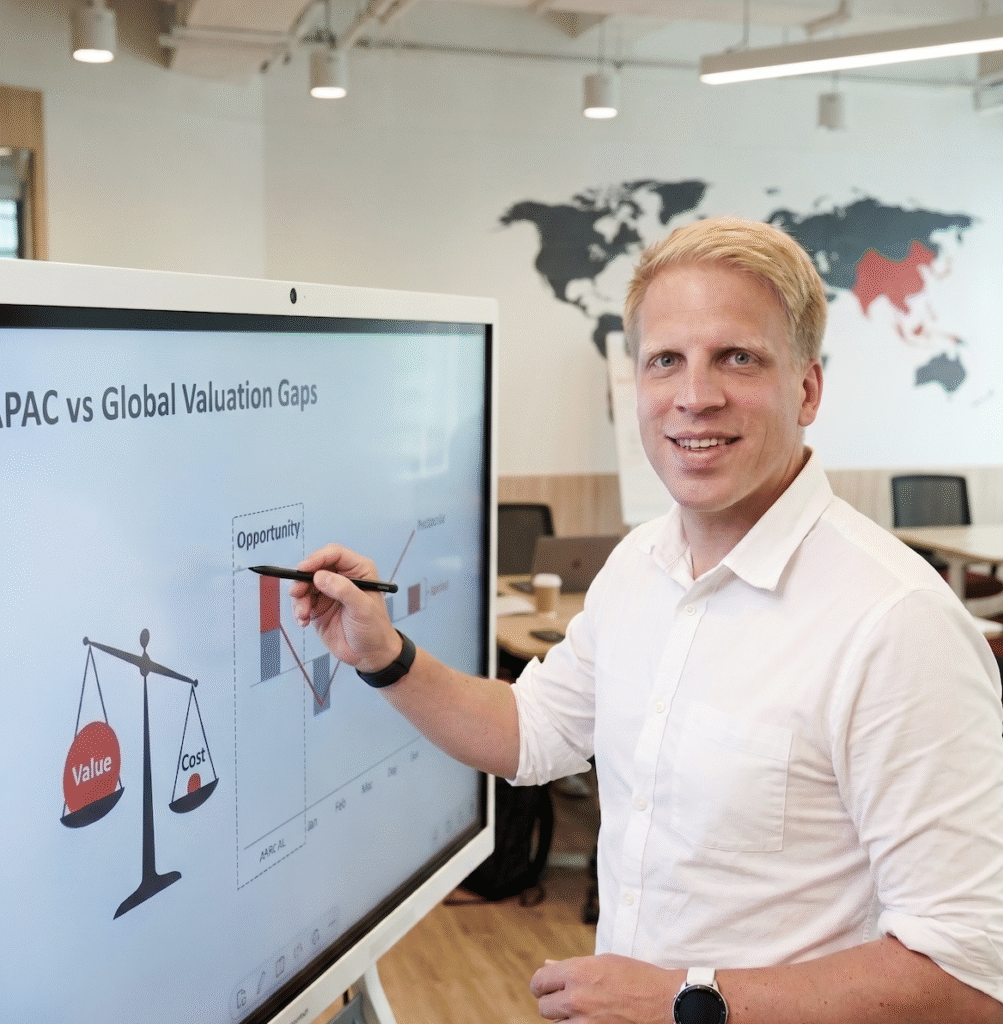
This is where APAC’s venture landscape becomes particularly compelling. Antler’s Seed Price Index, based on 150 seed investments made over two years, found a striking spread in entry valuations. Median seed valuations ranged from about US$25 million in the United States to roughly US$6-7 million in parts of Southeast Asia.
The difference was not explained by founders surrendering radically different amounts of equity. Dilution was broadly consistent across markets, suggesting a genuine price gap rather than a quirk in deal structure.
For investors, that creates the possibility of accessing globally ambitious companies at markedly lower entry prices. For founders, however, it is also a reminder that cheaper capital is not automatically better capital. The right investor must still bring networks, technical understanding and the ability to support international expansion.
As Grimeland put it, venture capital is not a Big Mac Index. The strongest companies increasingly raise from global pools of capital, recruit across borders and sell into international markets. Their early price may be local, but their potential outcome is global. This is arguably APAC’s most important opportunity: not to become a discounted version of Silicon Valley, but to turn local capital efficiency into global competitive power.
Selectivity is restoring the value of experience
The correction in venture markets is also changing what investors reward. Growth projections alone are less persuasive when capital is expensive and exits are uncertain. Antler is increasingly backing repeat founders and deep domain experts: people who understand not only how to launch a company, but why a problem is difficult and where incumbents remain vulnerable.
The shift is most pronounced in APAC. Among Antler-backed founders, the share that had founded a company before rose from 62 per cent in 2022 to 78 per cent in 2025. Europe moved from 58 per cent to about 68 per cent, while the Americas reached roughly 68–74 per cent over the same broad period.
Deep tech’s constraint is time, not imagination
Deep tech developments do not follow the frictionless scaling curves associated with consumer software. They require laboratories, hardware, regulation, specialised talent and long cycles of technical validation. AI can compress parts of research and development, but it cannot repeal physics, manufacturing or clinical evidence.
Grimeland said deep tech is moving from the margins to the centre of early-stage activity in APAC, which is now home to Antler’s largest deep tech portfolio, and that base has grown every year.
This should inspire confidence, but not complacency. The region’s advantage will be squandered if investors apply software timelines to scientific companies or retreat at the first difficult funding cycle.
APAC has the engineering talent, manufacturing depth and urgent real-world problems to produce global leaders. What it still needs at greater scale is capital willing to accompany founders from discovery to deployment.