
AI is ultimately constrained by physical infrastructure: power, cooling, manufacturing capacity and engineering expertise. These are rapidly becoming the strategic resources that will determine which countries emerge as AI leaders over the next decade.
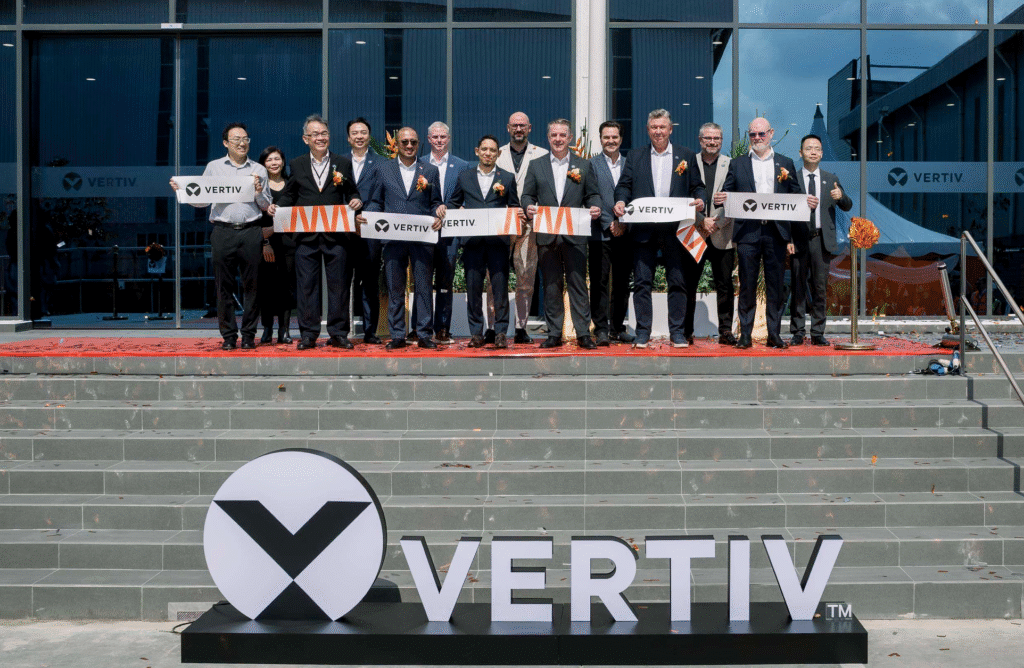
That is why Vertiv’s decision to establish a new manufacturing facility in Johor deserves attention beyond the usual corporate investment headlines. The expansion reflects a broader shift underway across APAC where AI infrastructure is becoming less about data centres alone and increasingly about building the industrial ecosystem capable of sustaining them.
During an interview with Deeptech Times at the opening of Vertiv’s Johor facility last week, Paul Churchill, vice president and general manager for Asia, described an industry that is evolving at a pace few anticipated only a few years ago.
AI is forcing infrastructure to evolve faster than ever
Unlike previous generations of enterprise computing, AI hardware no longer follows predictable refresh cycles.
Graphics processors are becoming dramatically more powerful with each generation, increasing rack densities while simultaneously creating unprecedented thermal challenges. Infrastructure vendors therefore find themselves redesigning products almost as quickly as semiconductor companies release new chips.
Churchill noted that Vertiv now develops new cooling technologies on an annual cadence rather than the traditional two- or three-year product cycles that once characterised the industry. The reason is straightforward: every new generation of AI accelerators demands significantly higher levels of cooling, engineering sophistication and power delivery.
For decades, infrastructure largely adapted to software. Today, software innovation is increasingly dependent on infrastructure innovation. The success of tomorrow’s AI models may depend as much on thermal engineering as on machine learning research.
The AI bottleneck is no longer compute alone
Much attention has focused on whether the world has enough GPUs. The more pressing question may be whether the world can power and cool them.
Churchill identifies land availability, power infrastructure, water access and government coordination as the fundamental ingredients that determine where AI infrastructure can scale. These factors increasingly outweigh traditional considerations such as geographic proximity to technology hubs.
This helps explain Malaysia’s rapid emergence as one of Southeast Asia’s most important AI infrastructure destinations.
Johor offers more than available land adjacent to Singapore. It provides the practical conditions necessary for hyperscale development: reasonable access to utilities, supportive government agencies and an expanding engineering ecosystem.
Perhaps more importantly, Malaysia is demonstrating something increasingly valuable in the AI era: the ability to move quickly. As AI investment accelerates globally, speed to deployment is becoming a competitive advantage in its own right.
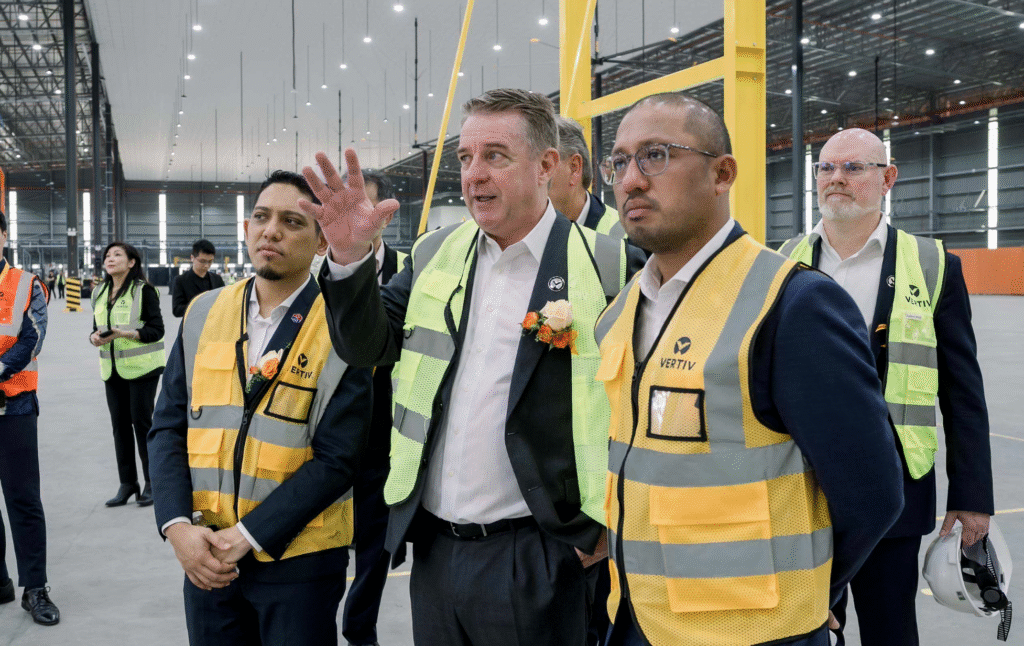
IMAGE: Vertiv
Liquid cooling is no longer optional
Perhaps the clearest sign of AI’s impact on infrastructure is the industry’s rapid transition towards liquid cooling.
Traditional air cooling is approaching its practical limits as chip densities continue to climb. Churchill estimates that today’s AI deployments typically require roughly a 30:70 mix between air and liquid cooling, with liquid expected to assume an even larger role as processing densities continue increasing.
This transition is not merely about keeping chips cool. Liquid cooling effectively extends the industry’s technological roadmap by allowing semiconductor manufacturers to continue increasing computational performance without overheating becoming the limiting factor.
In other words, liquid cooling is becoming an enabler of AI innovation itself. That also changes the economics of infrastructure. Cooling systems are evolving from supporting equipment into strategic assets that directly influence how much computing power organisations can deploy.
Edge AI will create a second wave of infrastructure
Today’s AI investment is largely concentrated inside hyperscale facilities. Churchill believes that will not remain the case. As inference workloads increasingly migrate closer to factories, offices and industrial environments, high-performance computing will become far more distributed.
Rather than massive hyperscale campuses alone, enterprises will begin deploying small clusters of powerful AI infrastructure on their own premises to minimise latency and support real-time decision making.
This evolution differs significantly from the earlier IoT narrative. IoT promised billions of connected devices but often struggled to demonstrate compelling economic value. AI, however, brings an entirely different equation.
Real-time inference can directly improve manufacturing efficiency, automate industrial processes and support mission-critical operations where milliseconds matter. That shift creates demand for a new generation of infrastructure: smaller than hyperscale data centres but considerably more sophisticated than traditional enterprise server rooms.
The power debate requires a more nuanced perspective
Much of today’s AI discussion centres on soaring electricity consumption. Churchill acknowledges AI’s growing appetite for energy but argues that focusing solely on absolute power usage misses the bigger picture.
Modern AI systems perform vastly more computation per watt than previous generations of infrastructure. From an efficiency perspective, AI hardware has improved by orders of magnitude.
The real question therefore is not whether AI consumes more power but whether that power generates proportionately greater economic productivity. If AI delivers measurable gains in manufacturing efficiency, software development, healthcare or scientific research, then the energy investment becomes economically rational. This is an important distinction that is often overlooked in public debate.
The challenge is less about eliminating energy consumption than ensuring the value created significantly exceeds the electricity consumed.
Manufacturing has become strategic infrastructure
Perhaps Churchill’s most revealing observation concerns manufacturing itself.
The new Johor facility is not simply expanding production capacity. It shortens supply chains, improves responsiveness and allows engineering teams to develop solutions specifically optimised for Asian operating conditions rather than adapting products originally designed for North America or Europe.
His description of “engineering in Asia for Asia” reflects a broader trend emerging across the region. AI infrastructure is becoming increasingly localised. As governments pursue digital sovereignty and enterprises demand faster deployment, regional manufacturing is evolving into a competitive advantage rather than merely a cost consideration.
The AI race is therefore becoming much more than a competition between semiconductor companies. It is also a competition between industrial ecosystems.
Countries capable of combining manufacturing, engineering talent, energy infrastructure, supply chain resilience and supportive public policy will increasingly define where AI capacity is built. Johor’s rise illustrates precisely that shift.
The future of AI will undoubtedly be written in software. But before that software can change the world, someone must manufacture the systems that power it, cool it and keep it running.