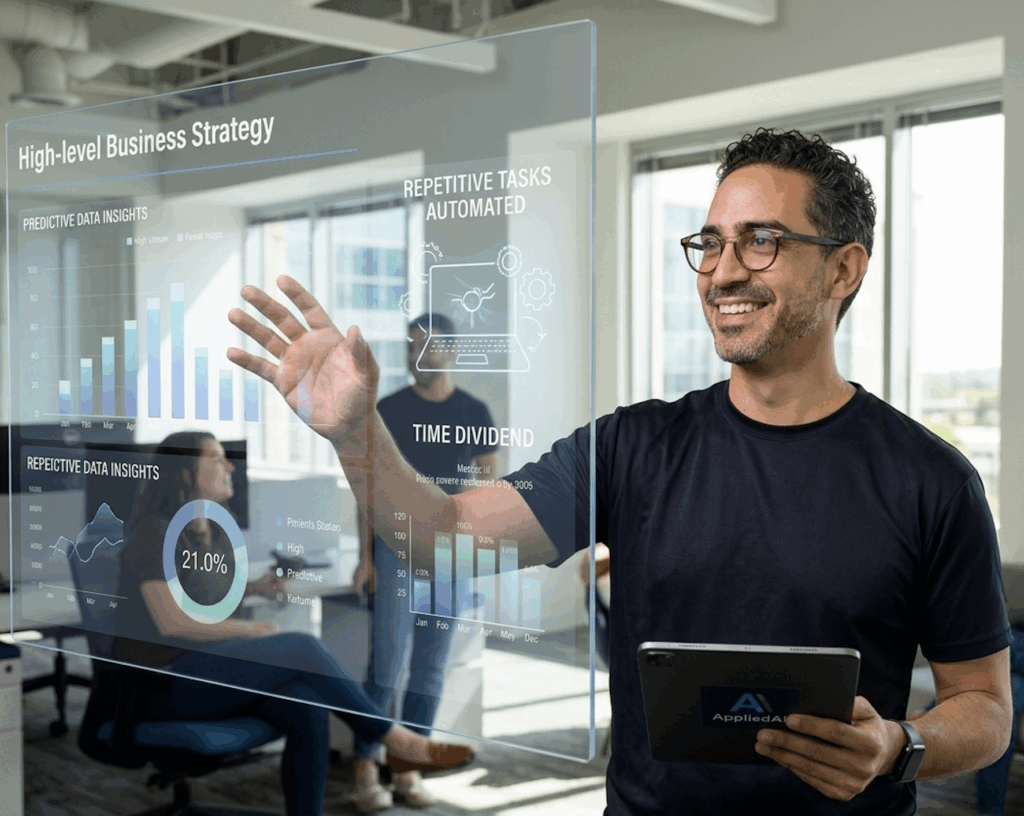
Image generated by Deeptech Times using Google Gemini
In the race to operationalise AI, most enterprises are still stuck in a paradox: unprecedented technological capability on one hand and stalled real-world impact on the other. For AppliedAI CEO Arya Bolurfrushan, this gap is a structural flaw in how organisations fundamentally understand and deploy AI.
At the centre of this rethink is Opus 2.0, AppliedAI’s flagship platform, which Bolurfrushan positions not as another enterprise tool, but as something far more radical: a “digital labour force”. We spoke to Bolurfrushan when he was in Singapore for the company’s APAC launch event.
The broken model of enterprise AI
The prevailing enterprise AI model, Bolurfrushan argues, is constrained by legacy thinking.
Organisations continue to treat AI as an incremental upgrade or another software layer to optimise workflows, rather than a transformative force that redefines how work itself is structured.
“The flaw is that we are underestimating the amount of change required,” he says, pointing to a complex interplay of adoption barriers, organisational inertia and psychological resistance.
More critically, enterprises have yet to solve what he sees as the central economic tension of AI: how to share productivity gains with the human workforce. Without aligning incentives, AI risks becoming a source of friction rather than acceleration.
This is particularly pronounced in regulated industries, where the stakes are higher and the consequences of failure tangible. But paradoxically, these sectors may also be where AI ultimately thrives.
The human-AI contract
Against a growing narrative that AI will fully automate knowledge work, Bolurfrushan offers a more nuanced and arguably more pragmatic vision.
Rather than eliminating humans, AI will force a renegotiation of their role.
“There has to be accountability,” he explains, citing real-world scenarios such as insurance claims or medical decisions. In these contexts, a human must ultimately bear responsibility – a legal and ethical anchor that AI alone cannot provide.
This creates what he describes as a “collaborative mid-mile” – a continuous interaction between humans and AI agents, rather than a simple handoff model where machines produce and humans merely validate.
It is a subtle but critical shift. In this model, humans are not reduced to oversight functions. They become active participants in a dynamic system where accountability, judgement and context remain indispensable.
From SaaS to digital labour
If the philosophical shift is significant, the economic implications are even more disruptive.
Opus 2.0 abandons traditional SaaS pricing models in favour of what Bolurfrushan calls “AI man-hours”. Enterprises are no longer buying software licenses but procuring labour capacity that is distributed across human workers and AI agents. This reframing has profound consequences.
First, it breaks the longstanding constraint of per-seat pricing, enabling organisations to scale AI usage without artificial limits.
Second, it forces leadership teams to confront a new optimisation problem: how to allocate work between humans and machines.
“You’re buying a certain number of man-hours,” he says. “The question is how many of those come from AI versus humans.”
In this world, productivity is no longer a function of headcount alone, but of orchestration: how effectively enterprises deploy a hybrid workforce of people and intelligent agents.
Why regulation is an advantage
Conventional wisdom suggests that regulation slows down innovation. AppliedAI is betting on the opposite.
By targeting highly regulated industries (financial services and healthcare), the company is deliberately operating at the hardest edge of enterprise AI deployment. These environments demand determinism, auditability and reproducibility; qualities often seen as constraints in AI systems.
But for Bolurfrushan, they are precisely what enable AI to scale.
“If you can solve AI for the most regulated, most consequential use cases, everything else becomes easier,” he argues.
This philosophy extends to AppliedAI’s expansion strategy in APAC. Markets like Singapore, Malaysia and Hong Kong are not just attractive because of their economic growth, but because of their policy clarity and institutional commitment to AI.
Singapore, in particular, stands out for its emphasis on process integrity, not just outcomes. This aligns closely with Opus’s architecture, which is designed to be fully auditable at the process level.
In effect, regulation becomes a forcing function for better AI systems: ones that can withstand scrutiny, manage risk and deliver consistent outcomes.
The APAC testbed
AppliedAI’s focus on APAC reflects a broader shift in the global AI landscape. While Silicon Valley continues to dominate foundational models, regions like Southeast Asia are emerging as critical testbeds for enterprise deployment.
Governments in Singapore and Malaysia, Bolurfrushan notes, are not merely endorsing AI but actively mandating its adoption through national strategies and incentives. This creates a unique environment where enterprises are both encouraged and compelled to modernize and accelerate the transition from experimentation to production.
At the same time, APAC’s diversity presents challenges: fragmented regulations, cultural nuances and varying levels of digital maturity. But for AppliedAI, these complexities are part of the opportunity.
Highly regulated, under-digitised industries, he argues, are primed for leapfrogging into the agentic future.
Beyond efficiency: The time dividend
Beyond enterprise metrics, Bolurfrushan frames AI’s long-term impact in more existential terms.
If AI succeeds in dramatically increasing productivity, it will not just reshape industries but also redefine how humans allocate their most scarce resource: time.
“Time and intelligence are the rarest commodities,” he reflects. By automating large swathes of work, AI could unlock a “time dividend” which enables individuals to pursue higher-order goals from creativity to self actualisation.
But this comes with a caveat. For many, work is a source of meaning. Remove it and society may face a different kind of crisis: one of purpose rather than productivity. In this sense, AI’s trajectory is not linear. It exists, as Bolurfrushan puts it, in a superposition of utopia and dystopia.
The notion of defining enterprise AI by systems of work rather than models is a bold one. Opus 2.0 is an attempt to build that system where humans and AI agents coexist, collaborate and co-evolve.
Whether this vision materialises remains to be seen. But one thing is clear: the conversation is shifting, and in that shift lies the real story of enterprise AI’s next chapter.