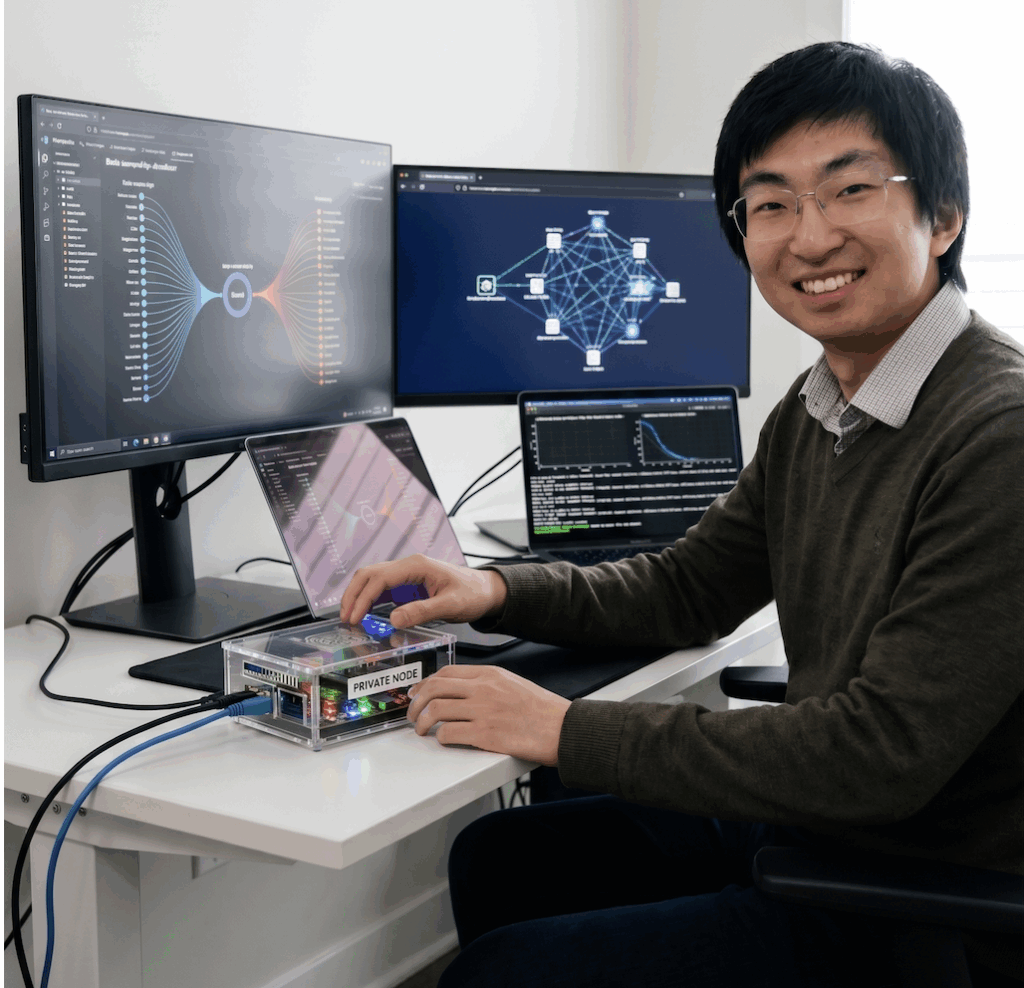
Image generated by Deeptech Times using Google Gemini
The history of modern computing has been defined by cycles of centralisation and decentralisation. From mainframes to personal computers, from on-premises servers to the cloud, each wave has reshaped not only how technology is deployed, but who ultimately controls it.
Today, AI stands at a similar inflection point.
According to SOLAI’s chief economist and vice president, Dr. Youwei Yang, AI is beginning to break free from its cloud-centric origins and move towards a more distributed, personal paradigm: one that could follow a trajectory strikingly similar to the rise of smartphones.
What is at stake is not merely the evolution of infrastructure, but a deeper question: who owns intelligence in the AI era?
The comparison between personal AI nodes and smartphones is more than a convenient metaphor. Smartphones did not simply miniaturise computing; they embedded it into daily life, making it persistent, personal and always within reach. In doing so, they shifted control away from institutions towards individuals.
Personal AI nodes, Yang argues, are poised to follow a similar adoption curve but with far greater implications.
“AI won’t stay purely in the cloud. We’re already seeing a split: cloud for scale, home and office devices for persistence and control,” Yang explains. “Personal AI nodes won’t copy smartphones exactly, but they follow a similar pattern. Once intelligence becomes local and always-on, ownership shifts closer to the user and become more day-to-day habit just like with smartphones.”
Unlike today’s cloud-based AI tools, which rely on remote servers and shared infrastructure, personal AI nodes operate locally within homes, offices or even individual devices. This shift introduces a new dimension of “always-on intelligence” that is both deeply contextual and inherently private.
Consider a legal professional whose AI node retains full case histories, client communications and sensitive documents without ever transmitting them to external servers. The benefits are immediate: enhanced efficiency, reduced latency, and crucially, control over highly sensitive data.
As Yang notes, “Professionals working with sensitive materials could gain the efficiency benefits of AI without the exposure that comes with routing data through third-party infrastructure.”
From access to ownership
The rise of cloud AI has largely been built on a model of access rather than ownership. Enterprises and individuals “rent” intelligence through APIs and platforms, often at the cost of data exposure and vendor dependency.
Personal AI nodes disrupt this model by relocating the locus of control.
“Ownership of intelligence will be layered,” Yang says. “Users own their data and local context, platforms provide models, and ecosystems connect everything.”
The critical shift lies in where computation happens. As more processing moves locally, sensitive workflows remain under the direct control of the user. This has profound implications for enterprises.
Traditionally, data sovereignty has been framed as a regulatory issue where data is stored and how it crosses borders. But personal AI nodes introduce a new variable: where data is processed.
“Enterprises will need to consider a new class of policy that governs not just where data is stored, but at what point it is processed and by whom, treating the employee’s device as a potential inference boundary rather than simply an endpoint,” Yang says.

Infrastructure is destiny
If personal AI nodes are to follow the smartphone trajectory, infrastructure will be the determining factor.
Yang’s perspective is shaped by SOLAI’s origins in large-scale Bitcoin mining – a domain defined by energy efficiency, hardware optimization and relentless cost discipline.
“Bitcoin mining taught us how to build electricity intensive infrastructure and operate compute at scale spanning power efficiency, hardware deployment, uptime and cost discipline,” he says. “Those same principles translate directly into AI infrastructure, just applied to inference instead of hashing.”
This is a critical point often overlooked in the current AI discourse, which remains heavily focused on models and software capabilities. In reality, the next phase of AI adoption may be constrained less by algorithmic breakthroughs and more by physical limitations: power consumption, compute density and hardware scalability.
In this sense, the emergence of personal AI nodes represents not just a shift in deployment, but a rebalancing of priorities. Hardware expertise, once considered secondary in the software-driven AI boom, is rapidly becoming central.
Open vs closed: The architecture debate
As with smartphones, the rise of personal AI nodes will be shaped by competing architectural philosophies.
Closed ecosystems offer tight integration and enhanced security, but at the cost of flexibility and independence. Open systems enable interoperability and rapid innovation, but introduce new security challenges.
Yang frames this not as a binary choice, but as a design problem.
“Open systems let different tools and models work together freely, which speeds up development and avoids being locked into a single provider,” he says. “The downside is that more openness means more entry points that need to be secured.”
Rather than choosing one over the other, SOLAI is pursuing what Yang describes as a middle path.
“Open at the top, so you can connect to any model or tool you need, with strong security built into the foundation so that openness doesn’t become a vulnerability,” he adds.
The APAC factor: Fragmentation as a catalyst
In highly heterogeneous markets such as Southeast Asia, the ability to operate across multiple systems is not a luxury but a necessity.
“Multi-system interoperability is not optional, especially in fragmented markets,” Yang highlights.
Different regions rely on different models, regulatory frameworks and infrastructure. AI systems must therefore be capable of dynamically routing across multiple environments.
“At SOLAI, we approach this as an infrastructure layer: enabling AI agents to select and switch between models based on latency, cost, compliance and task requirements,” Yang explains. “Systems that can’t operate across these dimensions simply won’t scale globally.”
Personal AI nodes, combined with intelligent model routing, could provide a powerful solution that anchors intelligence locally while enabling seamless interaction with global AI ecosystems.
Crypto-native infrastructure and the question of control
An often underexplored dimension of personal AI nodes is their intersection with blockchain and decentralised infrastructure.
“Crypto-native infrastructure applies blockchain primitives, distributed node networks, cryptographic verification and programmable access rules to AI compute,” Yang says.
The goal is to create systems where no single entity controls access or usage, a stark contrast to today’s platform-dominated AI landscape.
Whether this becomes mainstream, Yang suggests, will depend on geopolitical dynamics.
“AI access is already being used as a geopolitical lever,” he notes, pointing to export controls, regulatory restrictions, and platform limitations across different markets.
Towards a system-level future
Perhaps the most significant insight from Yang’s perspective is that the future of AI is not model-centric, but system-level.
“The future is clearly hybrid. But more importantly, it is becoming system-level rather than model-centric,” he says.
Cloud infrastructure will remain critical for scale. But intelligence is increasingly moving closer to where data is generated and decisions are made across edge devices, personal nodes and distributed networks.
“At SOLAI, we are building across hardware nodes, agent runtime, model routing and AI compute as a unified stack,” Yang explains. “We believe the next phase of AI depends on how these layers work together, not on any single model.”
The ownership of intelligence
The rise of personal AI nodes ultimately forces a reconsideration of a question that has largely gone unexamined: who owns intelligence?
In the cloud era, the answer has been ambiguous, split between users, platforms and infrastructure providers. Personal AI nodes bring clarity by anchoring a significant portion of intelligence at the user level.
But this is not a simple transfer of power. Ownership becomes more complex, more distributed and more dynamic.
Users gain control over their data and local context. Platforms continue to innovate on models. Ecosystems provide the connective tissue. The balance between these layers will define the next phase of the AI economy.
If smartphones made computing personal, personal AI nodes could make intelligence itself a personal asset: owned, controlled and shaped by the individual. And in that shift lies the foundation of a new digital order.