
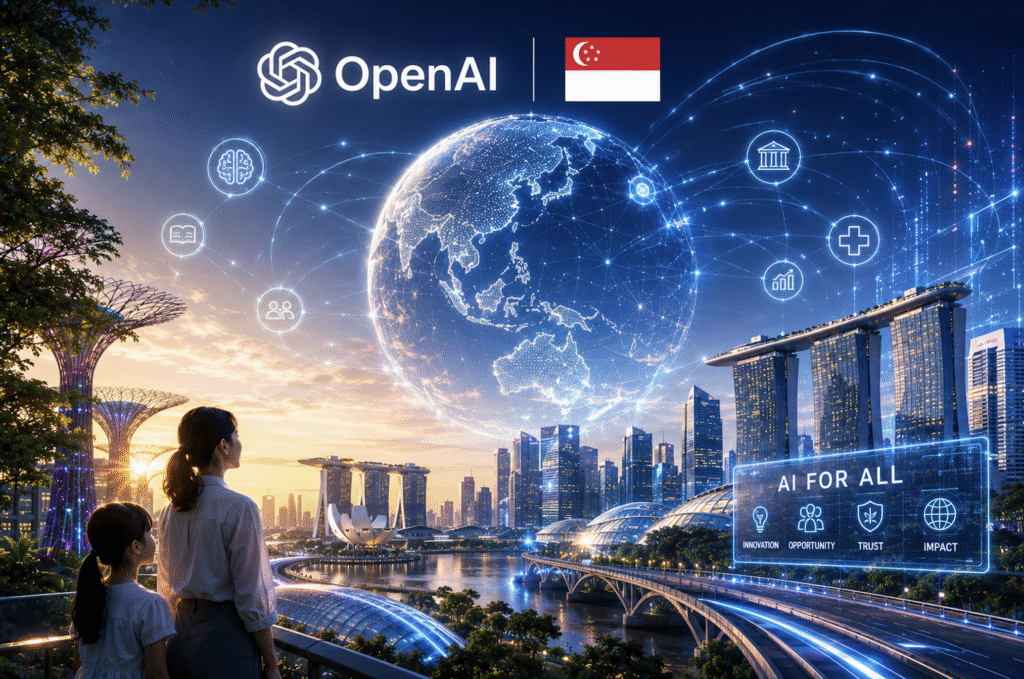
When OpenAI announced “OpenAI for Singapore” this week alongside Singapore’s Ministry of Digital Development and Information (MDDI), the headlines naturally focused on the numbers: more than S$300 million in ecosystem investment, a new Applied AI Lab, and over 200 specialised AI roles planned in the coming years. But the deeper significance of the announcement is not financial. It is geopolitical, industrial and strategic.
This partnership signals something far larger than another Big Tech expansion into APAC. It represents a decisive shift in how frontier AI companies may work with nation states in the coming decade; not merely as technology vendors, but as long-term infrastructure partners embedded into economic transformation agendas.
And for Singapore, it may become one of the most consequential AI positioning moves the country has made since launching its national AI strategy.
At the core of the announcement is the creation of OpenAI’s first Applied AI Lab outside the United States.
That detail matters enormously because frontier AI companies do not casually decentralise strategic capability. Training models may remain concentrated in a handful of global hyperscale locations, but the next phase of the AI race is increasingly about deployment, integration and economic orchestration.
Singapore has effectively positioned itself as a global proving ground for applied AI. The distinction is critical.
The AI industry is entering a phase where the winners will not necessarily be the countries with the largest compute clusters or the biggest foundation models. Increasingly, competitive advantage will come from the ability to operationalise AI at national scale across government services, finance, healthcare, education and enterprise ecosystems.
The OpenAI-MDDI partnership explicitly targets those areas. The initiative will support Singapore’s national AI missions in public services, finance, healthcare and digital infrastructure, while also introducing deployment-focused engineering talent programmes and startup acceleration initiatives.
This reflects an important reality that many governments are only beginning to understand: the future AI bottleneck is no longer just research talent but also deployment talent.
For years, the AI conversation revolved around model breakthroughs and research supremacy. But enterprises globally are now discovering that integrating AI into real operational environments is far more difficult than running a chatbot demo.
Organisations require engineers that understand workflow orchestration, security, governance, integration architecture, agentic systems and domain-specific deployment. OpenAI’s emphasis on Forward-Deployed Engineers (FDEs) is therefore strategically revealing.
The company is effectively acknowledging that the next battleground in AI is enterprise implementation. Singapore happens to be uniquely positioned for that transition.
Unlike larger economies that may struggle with fragmented regulation or legacy bureaucratic complexity, Singapore offers something increasingly valuable in the AI era: institutional coherence. Its public sector digitisation maturity, regulatory predictability, dense enterprise ecosystem and highly connected financial infrastructure create an unusually efficient environment for rapid AI experimentation and deployment.
In many ways, Singapore is becoming for applied AI what Switzerland historically became for global finance: a trusted neutral hub where international systems can interoperate.
That could have profound implications for the wider APAC region.
For Southeast Asia especially, the announcement reinforces Singapore’s growing role as the command centre for enterprise AI adoption. Regional governments and enterprises are unlikely to build sovereign frontier models at the scale of the U.S. or China. Instead, many will focus on practical adoption, regulatory adaptation and workforce transformation.
Singapore is now positioning itself to become the region’s AI translation layer: the place where frontier AI technologies are adapted into deployable economic systems for ASEAN and beyond.
The implications for regional talent flows may also be substantial.
The partnership includes OpenAI Academy initiatives, Codex hackathons for teachers, AI fluency programmes with IMDA and AI Singapore, and specialised training pipelines for mid-career engineers. This is not simply workforce development. It is ecosystem shaping.
One of the biggest global AI risks today is the emergence of a severe “AI capability divide” between countries that can operationalise AI and those that remain dependent on imported tools without domestic expertise. Singapore appears determined not to fall into the latter category. More importantly, it may be trying to ensure that ASEAN does not either.
There is also an unmistakable competitive message embedded within this announcement. Globally, governments are racing to secure strategic relationships with frontier AI firms.
France has courted AI infrastructure investments aggressively. The UAE has pursued sovereign AI positioning through partnerships and compute investments. Japan and South Korea are accelerating national AI agendas tied to industrial policy. China continues to advance its own sovereign AI stack.
Against that backdrop, OpenAI’s decision to anchor its APAC strategy in Singapore sends a powerful signal about where the company sees long-term geopolitical and commercial stability.
The timing is equally significant.
The global AI race is evolving from a pure technology competition into an ecosystem competition. The next decade will likely be shaped less by who builds the single most powerful model, and more by which countries successfully create AI-native economies.
That means rethinking education systems, public services, workforce structures, regulatory models and enterprise operating architectures. Singapore’s partnership with OpenAI directly targets all of those dimensions simultaneously.
Yet there are also important tensions beneath the optimism.
As countries deepen partnerships with frontier AI firms, questions around sovereignty, dependency and concentration risk will intensify. If AI increasingly becomes foundational infrastructure, governments will eventually need to decide how much reliance on foreign AI platforms is strategically acceptable.
Singapore’s approach appears pragmatic rather than ideological. Instead of pursuing full-stack sovereign AI independence, it is focusing on becoming indispensable within the global AI value chain. That may ultimately prove to be the smarter strategy.
In the semiconductor era, countries competed to own fabrication plants. In the cloud era, they competed to attract hyperscale data centres. In the AI era, the most valuable position may belong to countries that become indispensable orchestration hubs for deployment, governance, experimentation and trusted adoption.
Singapore is making a calculated bet that the future of AI will not be defined solely by where models are trained, but by where they become economically real.
OpenAI’s S$300 million commitment may therefore be remembered not merely as an investment announcement, but as an early marker of a much larger shift: the emergence of nation-scale applied AI ecosystems as the next frontier in global competitiveness.