

IMAGE: Diebold Nixdorf
Self-checkout was meant to improve retail economics. Instead, it exposed a new margin leak.
Retail shrink hit US$112.1 billion in 2022, according to the National Retail Federation (NRF), with external theft accounting for about 36 per cent of losses and operational failures and employee theft driving much of the rest. That helps explain why AI at checkout is gaining traction, not as a futuristic extra, but as a practical effort to make self-service pay.
That is the promise behind Vynamic Smart Vision, Diebold Nixdorf’s platform that uses cameras and machine learning to detect missed scans and prompt shoppers to correct them. The pitch is simple: improve the economics of self-service without ripping out existing systems or adding labour back into the lane.
Nino Hoerttrich, Diebold Nixdorf’s head of global marketing for retail, also pointed to early deployment results.
In one age-verification use case at a 24/7 store in Stuttgart Airport, more than 80 per cent of age-restricted transactions were automatically approved in the first week, reducing the need for staff intervention. The bigger investor question is whether such gains can deliver lasting margin improvement once hardware, integration, maintenance and false positives are factored in.
Shrink is real: The story around it is messier
That nuance matters. The NRF’s US$112.1 billion estimate made for a strong headline, but the underlying data showed shrink at 1.6 per cent of sales in 2022, up from 1.4 per cent a year earlier. It had increased, but not a rupture from previous years.
The Council on Criminal Justice also found a mixed picture across major U.S. cities, with shoplifting incidents in the first half of 2023 running 7 per cent below 2019 levels once New York City was excluded. For operators, the conclusion is less political than practical: shrink is a real cost centre, and much of it is operational.
That is probably why AI at checkout appeals to retailers. The opportunity is not only to catch obvious theft, but to reduce missed scans, tighten execution and make self-checkout economically credible again. In retail, the most valuable technologies are often the ones shoppers barely notice.
The system uses a rules engine to decide how to respond, said Hoerttrich. A missed scan may be treated as a simple mistake, prompting a gentle nudge for the shopper to correct it. Repeated missed scans in a single transaction, however, can trigger a firmer response.
A swapped barcode, by contrast, is more likely to signal deliberate fraud. In more obvious attempts to game the system, retailers can halt the transaction and alert staff immediately. How effective that response is depends on how the rules are configured.
Retailers embraced self-checkout to cut labour costs and increase throughput. But the model also introduced enough leakage and enough need for staff intervention that the savings were never as clean as promised. AI is now being sold as the missing layer: software that catches exceptions, reduces friction and preserves convenience without a full return to staffed lanes. It is not glamorous, but it is the kind of incremental fix that often wins in retail.
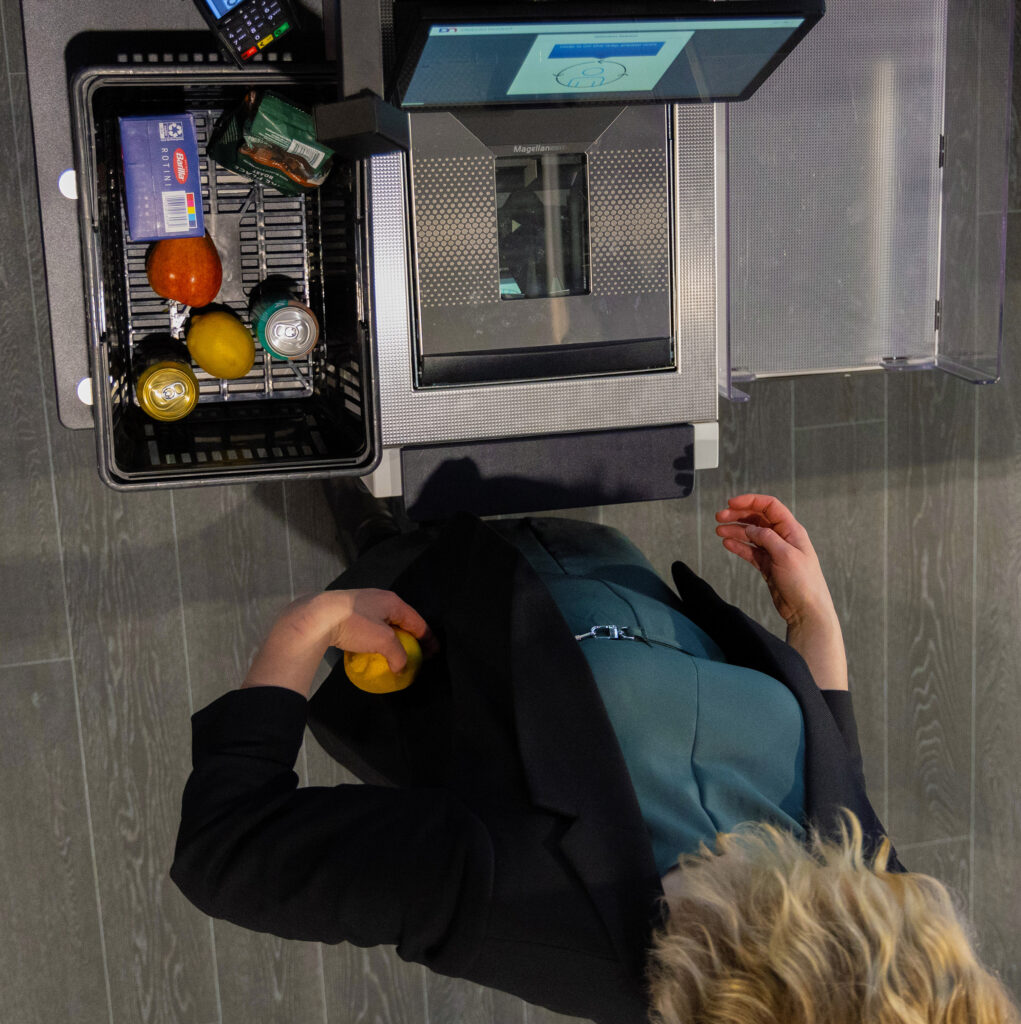
IMAGE: Diebold Nixdorf
What Amazon Go got right and missed
Amazon Go remains a useful reminder that impressive technology does not guarantee a scalable retail model. Cashierless shopping worked technically. The harder task was making the economics work consistently across formats and locations.
What appears to be gaining ground instead is a hybrid model: self-service backed by AI that flags exceptions and routes them to humans, rather than trying to remove labour altogether.
That also helps explain why retailers are combining computer vision with RFID, especially in apparel and other categories where inventory accuracy has long been inconsistent. The advantage is not any single tool. It is integration: linking what happens on the shelf, what enters the basket and what actually gets paid for.
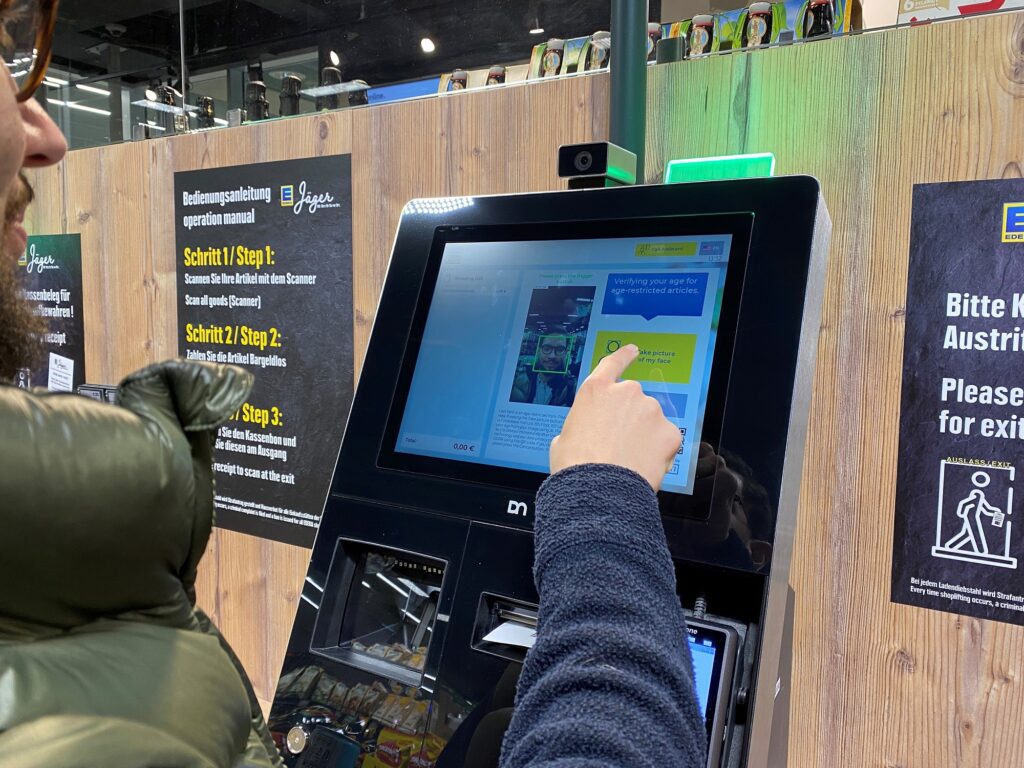
IMAGE: Diebold Nixdorf
Why deployment varies by store
Hoerttrich said deployments would vary by region and retailer. Camera views can include store-specific objects, and the system must learn to distinguish between items that should be paid for and those that should not, such as a magazine for sale and a free in-store brochure sitting in a basket.
Some issues, he said, can be addressed through additional AI training. Others require changes to store processes or checkout layout.
The latest version of Vynamic Smart Vision is built for less structured environments. It can distinguish between multiple shoppers at a self-checkout and match each person to the correct transaction. It can also tell whether an object in hand is an item for purchase or a personal belonging, such as a phone, wallet, umbrella or handbag.
The final test is simple: return on investment. If AI can materially reduce shrink, ease labour friction and keep checkout moving, it will become standard retail infrastructure. If not, self-checkout may be remembered as a case study in false efficiency, proof that in retail, convenience without control is just another way to lose money.