
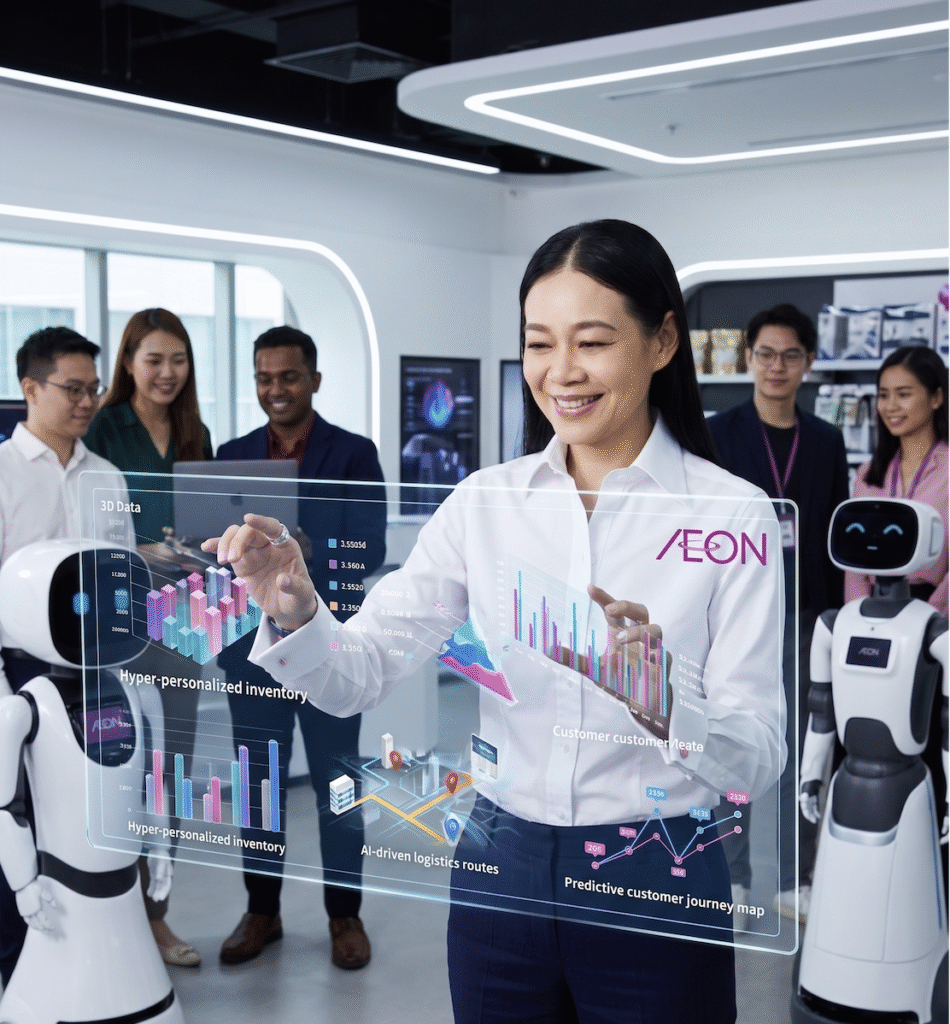
Image generated by Deeptech Times using Google Gemini
For decades, AEON won with a familiar retail formula: more stores, more inventory, more foot traffic. That era is over. In a market defined by real-time data, predictive intelligence, and personalised engagement, scale without insight is no longer a moat.
Low Ngai Yuen, managing director of AEON360 and an advisory board member for NRF 2026: Retail’s Big Show Asia Pacific (NRF 2026 APAC), is leading the group’s push to turn a traditional retail network into an intelligent, always-on customer ecosystem.
Formed as a joint venture between AEON Credit Service and AEON CO., AEON360 serves as the strategic intelligence layer across AEON Group’s businesses in Malaysia. Its mandate is straightforward but ambitious: unify membership, personalise engagement in real time, and create more value across retail, finance, digital and lifestyle services.
Solving for invisibility
Before this transformation, AEON was constrained by the kind of structural and technical fragmentation that prevents incumbents from operating as modern data businesses. Legacy Sato POS systems left transactions effectivelyanonymous at checkout, limiting personalisation, weakening promotional precision and obscuring who customers actually were.
That problem extended across the enterprise. Customer data sat in silos spanning supermarkets, department stores, malls and banking. Without a unified view, AEON360 could not track the full customer journey, identify high-value movement across touchpoints, or reliably deploy predictive models on top of fragmented, low-quality data.
The barriers were not only technical. They were organisational. Predictive analytics challenged established reporting habits, and AI-driven insights often met resistance when they did not align with long-standing dashboards and assumptions.
The solution required more than new tools. It required a shift in operating model, from backward-looking reporting topredictive decision-making. Since taking the helm in September 2025, Low and her team have focused on four core pillars:
A contextual intelligence engine
At the centre is a contextual intelligence engine designed to move beyond basic personalisation. Instead of treating each interaction as a fresh start, it uses prior purchases and behavioural signals to shape recommendations, anticipate needs and surface real-time inventory.
Advanced data infrastructure with BigQuery
Underpinning that platform is Google Cloud’s BigQuery, which AEON360 is using to build an enterprise knowledge graph. The objective is a single, reconciled view of the customer across entities and touchpoints: an essential foundation for scalable AI deployment.
Agent orchestration and AI deployment
AEON360 has also adopted a layered agent orchestration model, with a central agent coordinating specialised sub-agents across key functions:
- Shopping agents: Handle text, voice and image inputs to help customers build carts and complete consented actions.
- Customer experience agents: Resolve enquiries 24/7 and support human staff with real-time guidance.
- Internal hygiene agents: Clean product hierarchies and master data to keep information accurate over time.
Financial inclusion through AI
By analysing alternative signals, including the consistency of essential goods purchases, AEON360 can assess creditworthiness for customers outside the formal banking system, potentially expanding access to micro loans and buy-now-pay-later products.
From evangelism to scale
AEON’s transformation has progressed in clear phases, from internal advocacy and infrastructure building to ecosystem integration and regional expansion.
- Phase 1 (c. 2021-2024): Low spent three and a half years building the case internally that data had become a core strategic asset.
- Phase 2 (May 2024): The initiative moved from concept to active execution.
- Phase 3 (April 2026): AEON formalised its collaboration with Google Cloud, launching its agentic commerce roadmap.
- Phase 4 (late 2025-early 2026): A critical six-month effort established data-sharing agreements across five key AEON entities, protecting PII while enabling cross-business analysis.
- Phase 5 (current-end 2026): The immediate priority is standardising data feeds, with a year-end target of fully clean top-line and bottom-line metrics.
- Phase 6: Google Cloud and AEON are building the AEON360 Innovation Foundry in Kuala Lumpur to upskill staff, raise AI fluency and accelerate new solutions.
- Phase 7: AEON360’s data team now numbers about 60, and Low expects it to reach 90-100 by year-end, mostly in tech roles. The AEON app is still evolving, with a roadmap that includes replenishment prompts, household delivery, and proactive, preference-led offers. Malaysia is the starting point, but the broader plan is to expand these AI-led services across Southeast Asia.
Becoming a value ecosystem
The broader strategy is to move beyond product-led selling and towards journey-led solutions. In practical terms, that means supporting customer goals across life stages and use cases, not simply optimising the next transaction.
AEON360 is also positioning for a more open commerce model through the Universal Commerce Protocol (UCP), an emerging standard championed by Google. If adopted at scale, it could allow customers to engage AEON’s brands directly through Google Search via a business agent.
To support that future responsibly, AEON is developing a comprehensive AI policy centred on observability, control and traceability. In Low’s framing, the long-term measure of success is not sales alone, but ecosystem lifetime value; what she described as the depth of trust, participation and sustained engagement inside the AEON ecosystem.
That is why the scorecard extends beyond commercial uplift in retail and financial products. Strategic indicators, such as customer participation, review activity, feedback and willingness to share data with consent, matter as much because they signal whether the ecosystem is earning relevance and trust.
It is still early but AEON360 is already surfacing a larger lesson for incumbents: in the age of agentic commerce, competitive advantage will belong to retailers that can turn customer data into context, context into trust, and trust into long-term value.