Retailers have invested heavily in digital transformation over the past few years, rolling out self-checkout, mobile payments, omnichannel commerce and cloud-based platforms. However, many organisations still operate with fragmented systems where store operations, customer analytics, inventory management and workforce scheduling function independently.
NEC’s showcase at NRF 2026; Retail’s Big Show Asia Pacific (NRF 2026 APAC) suggested that the industry’s next phase lies in operational intelligence rather than standalone automation.
A key example was its agentic retail solution, developed with Supervity, which introduces AI employees capable of executing repetitive operational tasks while learning from previous decisions and exceptions. Rather than simply assisting employees, these AI agents can complete workflows across functions such as finance, procurement and inventory management, allowing staff to focus on higher-value customer interactions.
For retailers managing thousands of stores across multiple markets, this represents a shift from AI as a productivity tool to AI as an operational capability.
Turning existing infrastructure into business intelligence
Another notable theme was extracting greater value from infrastructure retailers already own.
NEC demonstrated its Mi-Eye platform, which transforms existing CCTV systems into business intelligence tools capable of analysing customer movement, dwell time and shopping behaviour without requiring entirely new hardware investments.
Many retailers across APAC have already invested significantly in surveillance systems and in-store sensors. AI now enables those systems to evolve beyond security into operational intelligence, helping retailers optimise store layouts, identify customer bottlenecks and improve merchandising decisions.
Bringing e-commerce intelligence into physical stores
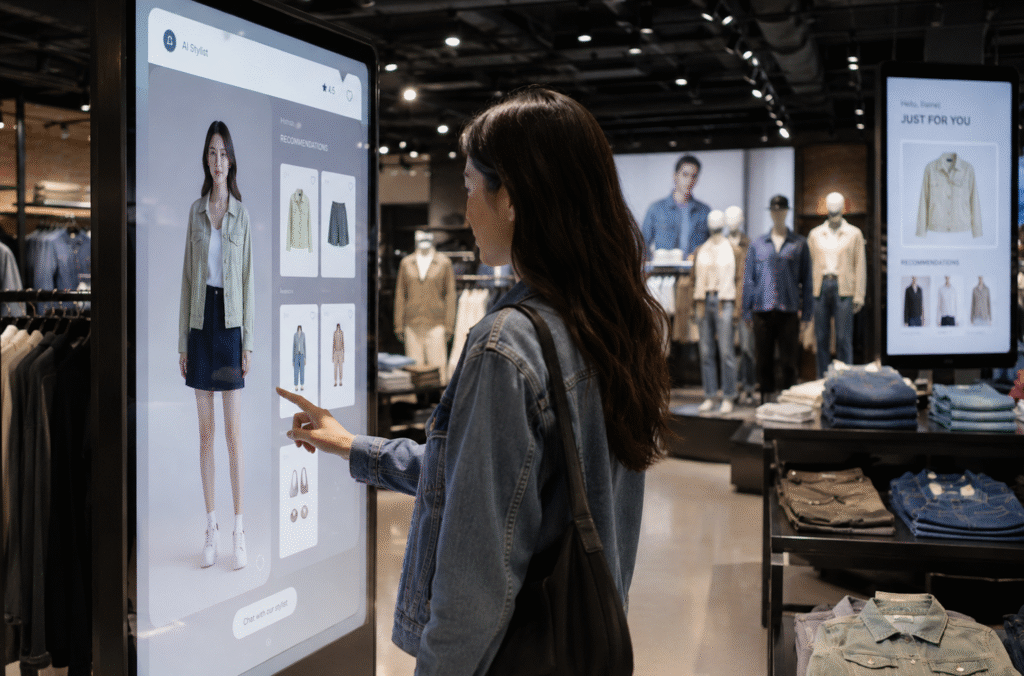
One of physical retail’s longstanding disadvantages has been visibility. Online retailers understand almost every stage of the customer journey—from searches and clicks to abandoned shopping carts. Physical stores, by comparison, have traditionally relied on sales data and manual observation.
NEC’s Online-Merge-Offline (OMO) capabilities aim to narrow that gap by combining in-store location data, beacon technologies and online customer behaviour into a unified view of the customer journey. The result is a smarter physical store where managers can make decisions based on behavioural insights rather than historical sales reports alone.
As retailers continue blending physical and digital experiences, understanding customers across both environments is becoming less of a competitive advantage and more of a business necessity.
AI still needs people
Despite the industry’s growing enthusiasm for automation, NEC’s demonstrations also highlighted the continuing importance of frontline employees.
Its smart device platform uses wearable smart glasses equipped with cameras, live video streaming and virtual assistance to guide store associates as they perform operational tasks. This approach reflects a growing reality across APAC retail.
Labour shortages are unlikely to disappear anytime soon, meaning retailers must not only automate work but also equip employees to become more productive from day one. Technologies that shorten training time and improve consistency may prove just as valuable as those that replace manual processes altogether.
In many ways, the future of retail AI is less about replacing workers than enabling them to make better decisions.
Intelligence requires resilience
As retail operations become increasingly connected, cybersecurity is becoming integral to business operations rather than simply an IT responsibility.
NEC showcased its CyIOC platform, which combines AI-driven threat detection with cybersecurity operations to help retailers secure increasingly digital and interconnected environments.
As retailers deploy more AI systems, connected devices and cloud-based platforms, the attack surface inevitably expands. Intelligent retail therefore requires intelligent security to ensure operational resilience and protect customer trust.
A glimpse of retail’s next chapter
NRF 2026 APAC once again demonstrated why APAC has become one of the world’s most dynamic retail innovation markets. The event brought together thousands of retailers, technology providers and industry leaders to explore how AI is reshaping commerce across the region.
NEC’s showcase captured an important shift taking place across the industry: retailers are moving beyond isolated AI pilots towards enterprise-wide intelligence that connects stores, employees, customers and operations into a continuously learning system.
The next generation of competitive advantage will come from orchestrating AI across the entire retail business, transforming stores from places that process transactions into environments that continuously learn, adapt and improve. That may prove to be the defining challenge and opportunity of the decade for APAC retailers.