

Image generated by Deeptech Times using Google Gemini
AI may be the most visible technological revolution of the decade, but much of the conversation around AI languages has focused on Python. Behind the scenes, however, another programming language is quietly becoming the backbone of enterprise AI infrastructure.
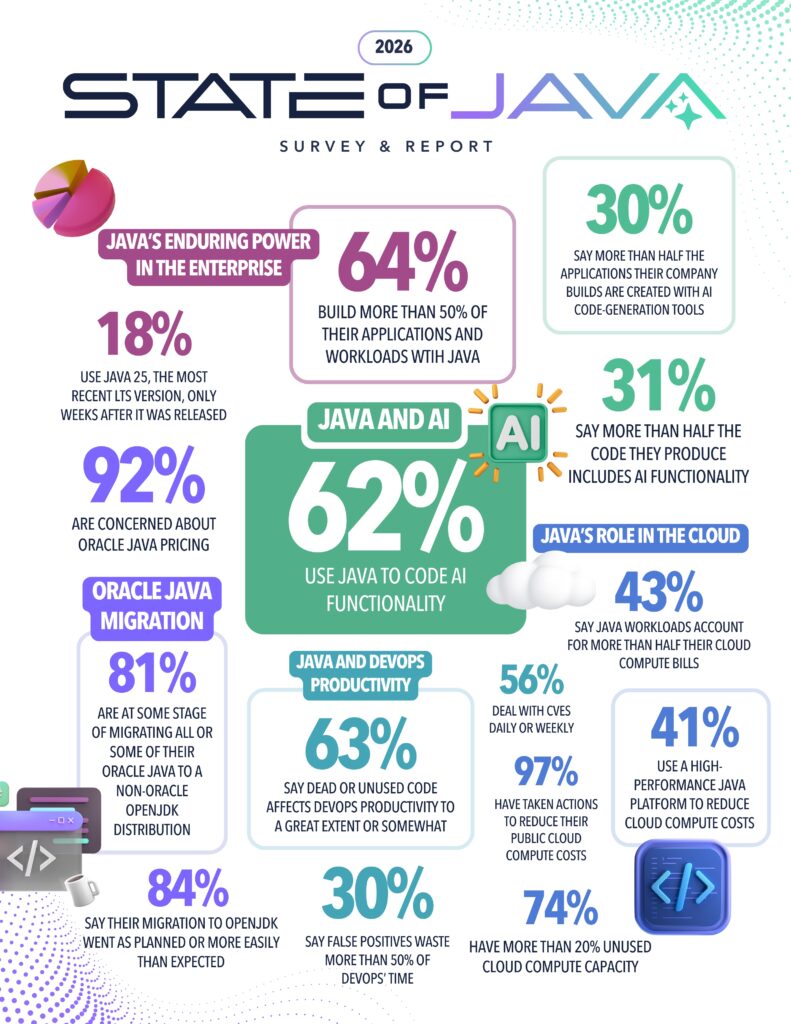
Insights from Azul’s 2026 State of Java Report reveal how Java is becoming indispensable in the AI era, particularly as organisations grapple with rising cloud costs and expanding infrastructure demands.
According to the report, which is based on the responses from 2,000 organisations worldwide, enterprises are increasingly relying on Java to power the complex backend systems that make AI possible. 62 per cent of enterprises now use Java to power AI functionality, while 41 per cent rely on high-performance Java platforms to optimise cloud computing costs.
Remarkably, across Southeast Asia, 69 per cent of enterprises have reported using Java for coding AI functionality, which is higher than the global average.
For many organisations building AI-driven systems, the shift is less about replacing Python and more about recognising the role of Java in the broader AI stack.
Dean Vaughan, vice president for APAC at Azul, says much of the real computing work behind AI occurs far beyond the user-facing models that typically dominate headlines.
“There’s the application that we interface with, where we see the AI and its outputs,” Vaughan explains. “Yes, many of those are written in Python but the real power behind AI is all the applications that sit behind it, and all those applications that make AI possible are written on Java.”
Java becomes the “glue” of enterprise AI
According to Azul’s latest predictions paper, enterprise-scale AI deployments will increasingly shift to Java as the “glue”, given its longstanding benefits spanning performance, reliability and robust security; making it an ideal backbone for production environments where AI is needed to integrate tightly with mission-critical systems.
The explosion of AI adoption is triggering a corresponding expansion in enterprise infrastructure: data pipelines, streaming systems, search engines and distributed databases. Technologies such as Kafka, HBase and Elasticsearch form the backbone of modern AI environments, processing enormous volumes of data that feed machine learning models and AI services.
“These technologies sit behind the front-end AI applications,” Vaughan notes. “They’re really the mainstay of what brings everything together. And so, as AI grows and proliferates, so too does the requirement and the expansion of these applications, and the real power is that they all run on Java.”
As AI systems grow more sophisticated, the demand for backend infrastructure continues to expand. That infrastructure, in turn, relies heavily on Java-based platforms.
In other words, while Python may dominate AI experimentation and model development, Java increasingly powers the operational layer where AI systems must scale reliably across enterprise environments.
This dynamic helps explain why Java adoption is accelerating in AI contexts. Rather than competing directly with Python, Java is emerging as the language that enables AI to operate at enterprise scale.
AI’s compute problem
Another powerful force driving Java’s resurgence is the soaring cost of cloud infrastructure.
AI workloads are notoriously compute-intensive. Training models, running inference, processing data streams and maintaining real-time services all require vast amounts of computing resources, particularly when deployed across large enterprise environments. The result is that many organisations are facing rapidly escalating cloud bills.
While cloud providers offer tools to monitor usage and optimise resource allocation, Vaughan notes that such measures can only go so far. Increasingly, the most forward-thinking organisations are exploring deeper architectural changes.
“Cloud budgets are a big problem for customers. They have been for a while. The smartest customers we’re working with are the ones really looking to reduce cloud costs and re-architecting the stack,” he says.
This is where Java optimisation is becoming strategically important.
High-performance Java and the economics of AI
One of the key findings in Azul’s report is the growing adoption of high-performance Java platforms designed to increase efficiency and reduce infrastructure costs.
Traditional OpenJDK implementations remain widely used, but organisations are increasingly exploring optimised Java runtimes capable of delivering faster application performance. That performance gain can translate directly into cost savings.
“If I can get a faster Java sitting inside the stack, that equates to faster application performance,” Vaughan explains. “And if I can derive faster application performance, then I have a choice.”
Companies can either pass the performance improvement to customers to improve response times and user experience, or use the efficiency gains to reduce the compute resources required to run the application.
“And if I reduce the compute, that’s where I really get savings from my cloud providers,” he adds.
These savings can be substantial, particularly for organisations operating large distributed systems in hyperscale environments.
“Replacing standard OpenJDK with high-performance Java speeds up the application,” he adds. “You can run the same application with less compute, and that’s where the real savings are.”
Java’s quiet resurgence
The growing intersection between AI infrastructure and cloud economics is driving a quiet resurgence for Java – a language first introduced nearly three decades ago but now finding renewed relevance in the AI era.
According to Azul’s survey, Java is seeing some of its fastest growth in AI-related workloads.
“We saw a significant growth of Java as a programming language for AI,” Vaughan says, referencing the findings of the company’s global survey of 2,000 organisations.
Much of that growth is happening in the layers of enterprise architecture that support AI applications such as data ingestion, streaming analytics, distributed search and backend services.
These environments require reliability, scalability and performance – qualities that have long made Java a cornerstone of enterprise software development. As AI moves from experimentation to production-scale deployment, those characteristics are becoming increasingly valuable.
The enterprise AI stack
For enterprises building AI-powered services, the future will likely involve a hybrid ecosystem of programming languages and technologies. Python will continue to dominate the data science and model development landscape. But Java will increasingly underpin the operational infrastructure that allows AI systems to run securely, efficiently and at scale.
“AI is driving huge Java adoption,” Vaughan says. “Mainly in all the applications that make it possible.”
In that sense, Java’s growing role in AI is not about competing for attention. It is about enabling the infrastructure that allows AI to function in the real world. As enterprises push AI deeper into their core operations, the technologies that power the backend may ultimately prove just as important as the models themselves.
And for many organisations, that invisible engine is Java.