
If someone told me there is a tool that could detect high-end fakes in a matter of seconds, I would have laughed them off as delusionary. Not anymore.
Enter Bunjang, a tech-driven recommerce platform from South Korea. Fed up with having to deal with perfect counterfeits parsing through its platform, the company is fighting back with a new technology that shifts authentication from art to hard science.
And no wonder. LUX.R, a consignment arm of popular pre-loved luxury reseller EcoRing Singapore projected that the second-hand luxury market is hitting over S$50 billion by 2026. Fakes are now so sophisticated they can fool even seasoned human experts, threatening to collapse consumer trust in the booming ‘recommerce’ sector.
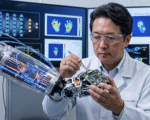
Bunjang’s Corelytics is an AI-powered system that can confirm a product’s authenticity in as little as 6 seconds with 99.9 per cent accuracy. Rather than relying on visual inspection, Corelytics uses X-ray fluorescence (XRF) to non-destructively analyse the micro-elemental composition of a product’s materials – its metal hardware, leather or jewels.
In simple terms, it’s like decoding a product’s “material DNA”.
“Even when two luxury products appear identical to the human eye, Corelytics looks beneath the surface, analysing the micro-element composition within the hardware or material to detect counterfeits and subtle differences invisible to conventional inspection,” explained Jina Kim, Head of Bunjang’s scientific authentication division.
Kim expanded, “Corelytics is a hybrid AI authentication system combining three key layers: human expertise, scientific verification and deep learning.” The company developed the system by adapting pharmaceutical-grade non-destructive analysis methods originally used to identify fake medicines.
The process combines human inspection, scientific verification and AI analysis. Bunjang authenticators analyse up to 18 key aspects of each product across 154 checkpoints, then they scan the goods using XRF and digital microscopy, where Corelytics captures each item’s “material DNA” analysing trace-element compositions that reveal microscopic differences invisible to the human eye. Finally, a proprietary machine-learning model trained on hundreds of thousands of authentic and counterfeit data points predicts authenticity in under 6 seconds with 99.9 per cent accuracy.

Since the model is built on continuous data input from new inspections, its accuracy and intelligence improve over time. Essentially, the more items Corelytics analyses, the smarter and faster it becomes. By combining this scientific, ‘DNA-level’ material forensics with its vast database of inspection data and advanced AI deep-learning algorithms, Bunjang is setting a new global standard.
The technology, which made its debut at a conference attended by the head of the World Intellectual Property Organisation (WIPO), aims to restore confidence in the resale market, where a single doubt about a product’s authenticity can erase its entire value.
The threat: When fakes go ‘perfect’
The recommerce industry (the business of selling second-hand goods) is growing faster than the primary luxury market, driven by consumers who value sustainability and investment. In this ecosystem, trust is the true currency, and a single doubt about an item’s authenticity can erase its value entirely.
However, counterfeiters are no longer using back-alley methods. They now employ sophisticated technology like computer-numerical-control (CNC) machining and 3D scanning to replicate dimensions, logos, and even casting techniques with near-perfect precision. These ‘super-fakes’ are challenging the expertise of seasoned human authenticators, leading to major seizures by customs agencies across Asia. In Singapore alone, authorities confiscated over S$3.7 million worth of counterfeit goods in 2024.
Bunjang’s Corelytics offers a defence that constantly adapts to these evolving threats. The system’s confidence is reflected in Bunjang’s guarantee: its inspection service, Bungae Care, pledges a 200 per cent compensation if an authenticated product is later found to be counterfeit – a powerful commitment to consumer protection.

The future: Authentication for everyone
Bunjang currently operates two authentication centres in South Korea, inspecting roughly 50,000 luxury items annually across all major brands. Each inspection contributes to what is now considered the world’s largest authentic-versus-counterfeit database, which in turn trains Corelytics’ AI models.
However, Bunjang isn’t stopping at the platform level. The company is actively working to democratise this technology, taking the power of “material DNA” testing out of the lab.
Jaewha Choi, CEO of Bunjang, stated the company’s ultimate goal is to accelerate the development of portable, miniaturised inspection devices and put powerful forensic tools directly into the hands of law enforcement for field verifications. Eventually, even consumers will be able to authenticate items directly at flea markets or smaller second-hand marketplaces.
As the second-hand market continues its aggressive expansion, AI systems like Corelytics are poised to become a critical defence in the recommerce industry, ensuring that consumers can invest in pre-owned luxury with genuine, scientific confidence.